Recipe from Dr. Chekhov: Khabensky turned the classic vaudeville of the Moscow Art Theater into rock'n'roll to the songs of "Auctioneer"
- Статьи
- Culture
- Recipe from Dr. Chekhov: Khabensky turned the classic vaudeville of the Moscow Art Theater into rock'n'roll to the songs of "Auctioneer"


Can a furious duel over old debts turn into a passionate declaration of love? Is family happiness worth the scandal over the rights to a piece of land? The artistic director of the Chekhov Moscow Art Theater staged the vaudeville "Love, Debts and Haymaking" on the Small Stage. The play is based on Anton Chekhov's one-act joke plays "The Bear" and "The Proposal", which the director combined into a single concept of wedding excitement and accompanied by songs by the band "Auctioneer".Izvestia visited the premiere and found out what, according to the director, Chekhov's characters are "sick of."
Who replaced the formidable Bear?
For the Art Theater, this production is a historical precedent: the Moscow Art Theater has never addressed the "Bear" joke, and the "Proposal" was staged only once, back in 1990. Konstantin Khabensky himself once started with this drama: in a graduation performance in LGITMiK, he played Lomov's suspicious fiance from the "Proposal". Years later, the director returns to the author with the conviction that Chekhov's vaudeville is fundamentally different from its French counterpart in the genre. On the stage, two Chekhov plots are combined on a common theme — about preparations for a wedding. In both absurd comedies, scandals and quarrels eventually lead the characters to the altar.
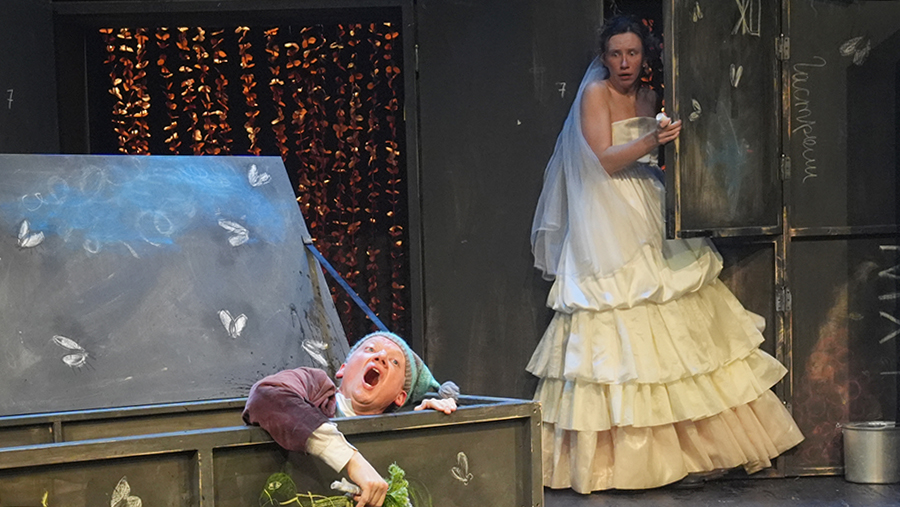
"I wanted this to be a story about beautiful people who often don't hear each other, but try their best to be happy," Konstantin Khabensky shares his idea. — Chekhov's vaudeville makes you fantasize about a person. It is especially evident in this material that Chekhov is a doctor. All the characters seem to have a diagnosis. But I rather started from Meyerhold and thought: What do they have in their pockets, what do they work with, what do they live with on a daily basis?

The visual world created by set designer Nikolai Simonov has turned a low price into a huge theatrical warehouse that hides from the audience behind a cheap polyester curtain. To emphasize the connection with the Moscow Art Theater, a seagull, the symbol of the theater, is painted on it in white paint. The sets are built from tour trunks and boxes, on which the names of the Moscow Art Theater performances are written in chalk. Toys keep falling out of these boxes, piles of papers are scattered, and an electronic piano is hidden in the largest storage. Behind him is the main character of "The Bear" Elena Ivanovna Popova (Elizaveta Ermakova). She performs the songs of the band "Auctioneer". The actress reworked the piano tracks herself. Devoid of concert drive, this version does not argue with Chekhov's prose, but carefully emphasizes its nuances: awkward pauses, unspoken feelings, the inner tension of the characters.
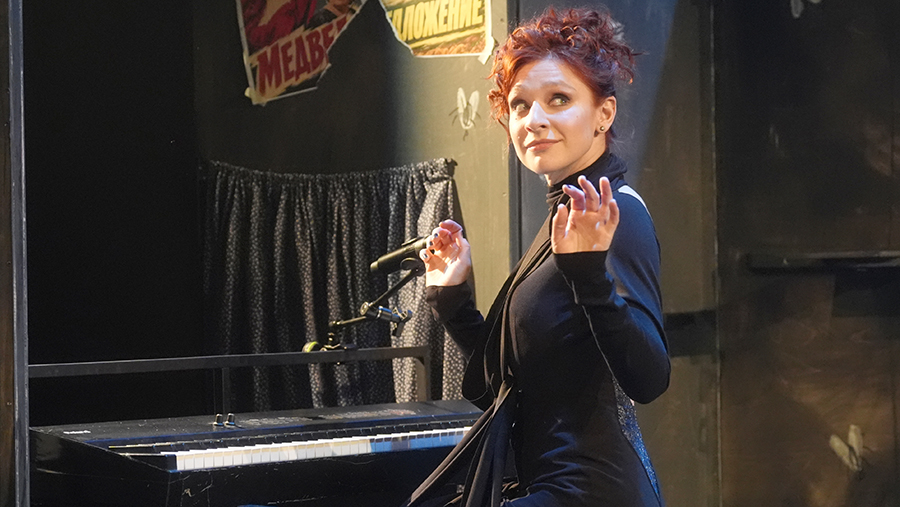
Khabensky's production also features original rock versions. The viewer suddenly sees a subtle psychological story in light comedic collisions: Chekhov's habitual intonations become closer to today's viewers, and the absurdity of everyday quarrels is highlighted by a sound that both makes them laugh and makes them sympathize.
The first act is a radical reinterpretation of the famous Chekhov joke. The historical benchmark of this vaudeville is the legendary 1938 film by Isidor Annensky, where the great artist of the Moscow Art Theater Olga Androvskaya shone. Her Popova on the screen was a flighty, flirtatious and absolutely confident woman. But Khabensky and his actors are building completely different psychological shifts.
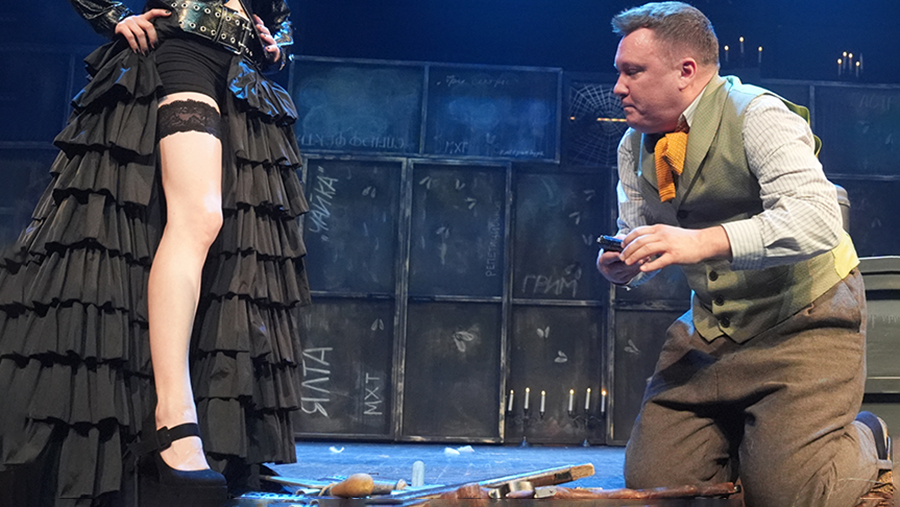
Elena Popova, played by Elizaveta Ermakova, at first glance seems to be a weak and inconsolable widow who locked herself in four walls and vowed fidelity to her husband, a traitor, to the grave. However, her proud, hot-tempered character manifests itself instantly, as soon as an assertive creditor, Grigory Stepanovich Smirnov (Artyom Volobuyev), appears on the threshold. When the degree of mutual insults reaches its peak, Popova herself resolutely suggests that the offender shoot himself. Moreover, she carries the weapon not in a velvet case, but on a huge tray. There are dueling pistols mixed in with rolling pins, hammers and pliers.
Smirnov, played by Volobuev, is infinitely far from the brave soldier Zharov. At the Moscow Art Theater, this is a scared, insecure man in a funny knitted hat with a pompom, who frankly gives in to an enterprising widow and is scared away by her servants. By the way, the director strategically replaced the classic servant Luka with the laconic but incredibly colorful Lukerya. Why — it will become clear in the finale. Maria Sokova plays this role with only her eyes and her trademark rolling laugh, instantly infecting the audience. In addition, unlike the hostess, Lukerya does not wear mourning — her outfits are the brightest and most pretentious on stage.
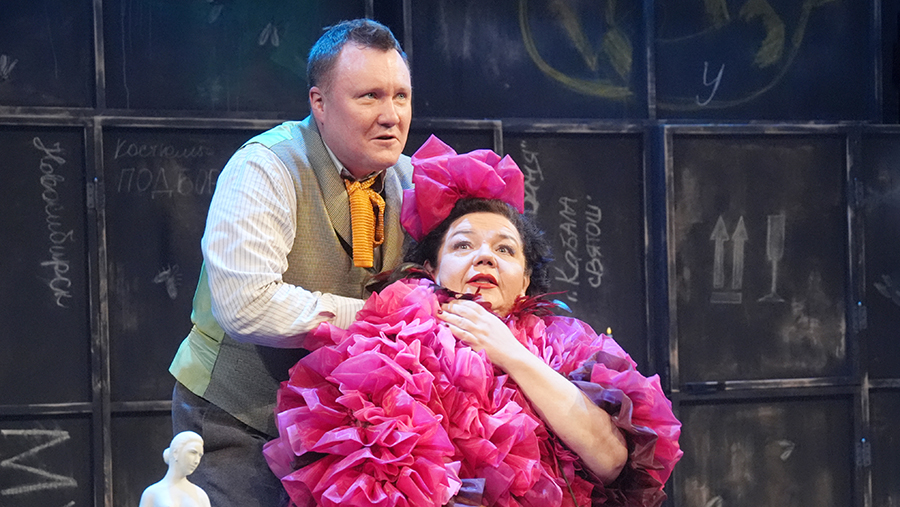
The performance was prepared on a tight schedule: rehearsals began back in February. Combining them with the duties of the artistic director of the Moscow Art Theater and the rector of the Moscow Art Theater Studio School is an extreme task, so the director approached the casting uncompromisingly. In his opinion, only first-class actors can play in vaudeville, because only the best can control such a frenzied range of feelings. And since there are only six roles in the play, the concentration of talents is obvious.

Family happiness with a hammer drill at the ready
The second act takes the viewer into the abyss of the homeric neighborhood commotion of the "Proposal". Suspicious and suffering from panic attacks, Ivan Lomov (Pavel Vorozhtsov) visits his old friend Stepan Chubukov (Vladislav Vetrov) to ask for the hand of his daughter Natalia (Polina Romanova). However, it never gets to romance: the bride and groom arrange grandiose scandals — first because of the rights to Cow Meadows, and then because of whose hunting dog is better.
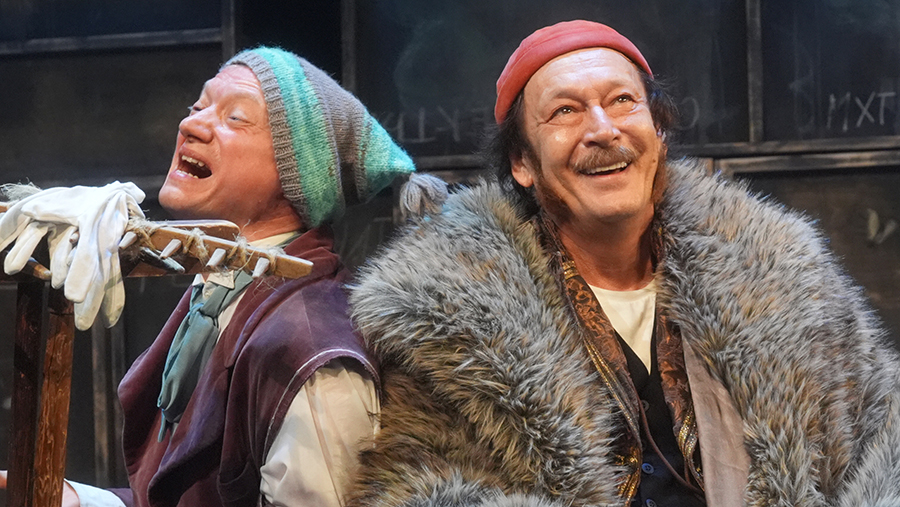
Pavel Vorozhtsov got the most in this eccentric turmoil. His Lomov is a complete hysteric, teetering on the verge of fainting and swallowing pills by handfuls. The actor has to work with complex special effects.: his character is literally shaking from panic attacks and electrocuted. Being the fiance of the active Natalia is still a test. This young lady's hands are on fire: in the morning she is at the hayfield, and in the afternoon she is in the workshops soldering, sawing and chiseling. Until Natalia calms down, the sound of a hammer drill resounds deafeningly over the Small Stage.
People's Artist of Russia Vladislav Vetrov has a special connection with Chekhov. Both are natives of Taganrog. And just a few days ago, on October 18, at the Aurora Cinema in St. Petersburg, as part of the Message to Man festival, the premiere of Marlen Khutsiev's long-running film Nevechernyaya, in which Vetrov played Anton Pavlovich, took place. The film was shot for 17 years, and almost a quarter of a century went to the screen. Now, from deep philosophical film reflections about the writer, the actor has stepped right into his sparkling theatrical vaudeville.
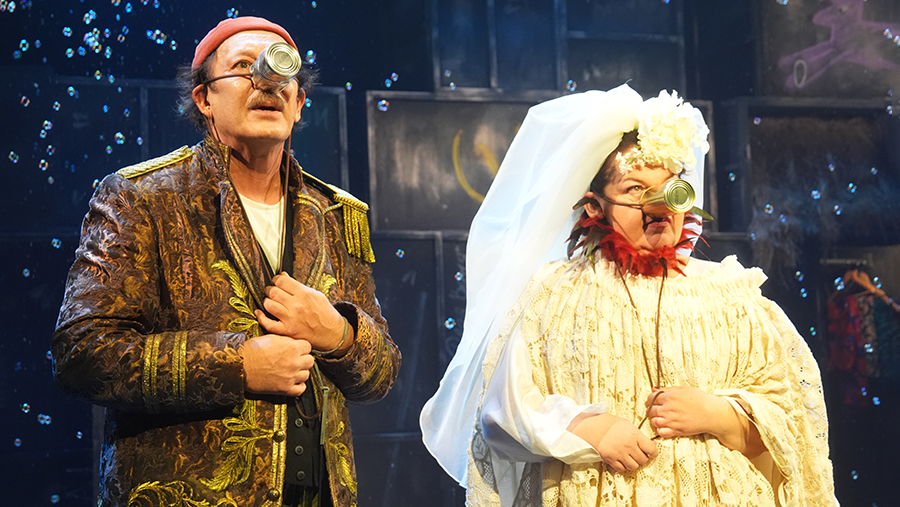
Konstantin Khabensky decided to rewrite the ending of the "Proposal" and find a bride not only for Chubukov's daughter, but also for the landowner himself. Lukerya's maidservant becomes the ideal match. Happy, they go to the curtain together to catch flies and put them in tin cans.
"Love, Debts and haymaking" proves that Chekhov's characters remain alive and understandable. Behind their cries about money, the boundaries of Oxen Meadows, and the virtues of dogs, they hide a desperate desire to be heard and loved. And it seems that the Moscow Art Theater has written out the perfect recipe for the autumn blues — loud, therapeutic laughter, including at oneself.
Переведено сервисом «Яндекс Переводчик»
