It will be anomalous: the United States is ready to search for extraterrestrial civilizations together with Russia
- Статьи
- Science and technology
- It will be anomalous: the United States is ready to search for extraterrestrial civilizations together with Russia


Russia and the United States can jointly implement projects to search for intelligent life in the universe, said Avi Loeb, head of the Scientific Advisory Council on Unidentified Anomalous Phenomena at the White House, an astrophysicist from Harvard. In his opinion, research should focus on finding traces of bacteria on exoplanets and signs of extraterrestrial artificial intelligence. Currently, both countries are conducting such research separately, and cooperation between them is not conducted for political reasons. However, experts believe that working together in this area may well become a "reset button" for Russian-American relations. At the same time, the search for other civilizations is a planetary—scale task.
A joint search for alien intelligence
Cooperation between Russia and the United States in the field of scientific search for extraterrestrial life and alien civilizations should develop in several directions, Avi Loeb believes.
— Collaboration can cover a wide range of space projects. In the context of the search for life, this may be a partnership in the scientific search for chemical traces of microbial life on exoplanets or technological signs of extraterrestrial civilizations. Including traces of extraterrestrial artificial intelligence," he told Izvestia.
According to the scientist, AI-dominated societies may be located in a "technological zone" around their star, which is much wider than the "habitable zone" suitable for biological life forms. Their data centers and other infrastructure can be located near the stars for efficient energy supply. Another sign of such civilizations may be the use of self-replicating robots.
— We could search for related "unidentified anomalous phenomena" in our "surroundings" — within the Solar System, — said the astrophysicist.

He also noted that students from Russia could apply for graduate studies at the faculties of physics or astronomy at Harvard University and participate in scientific research in this field.
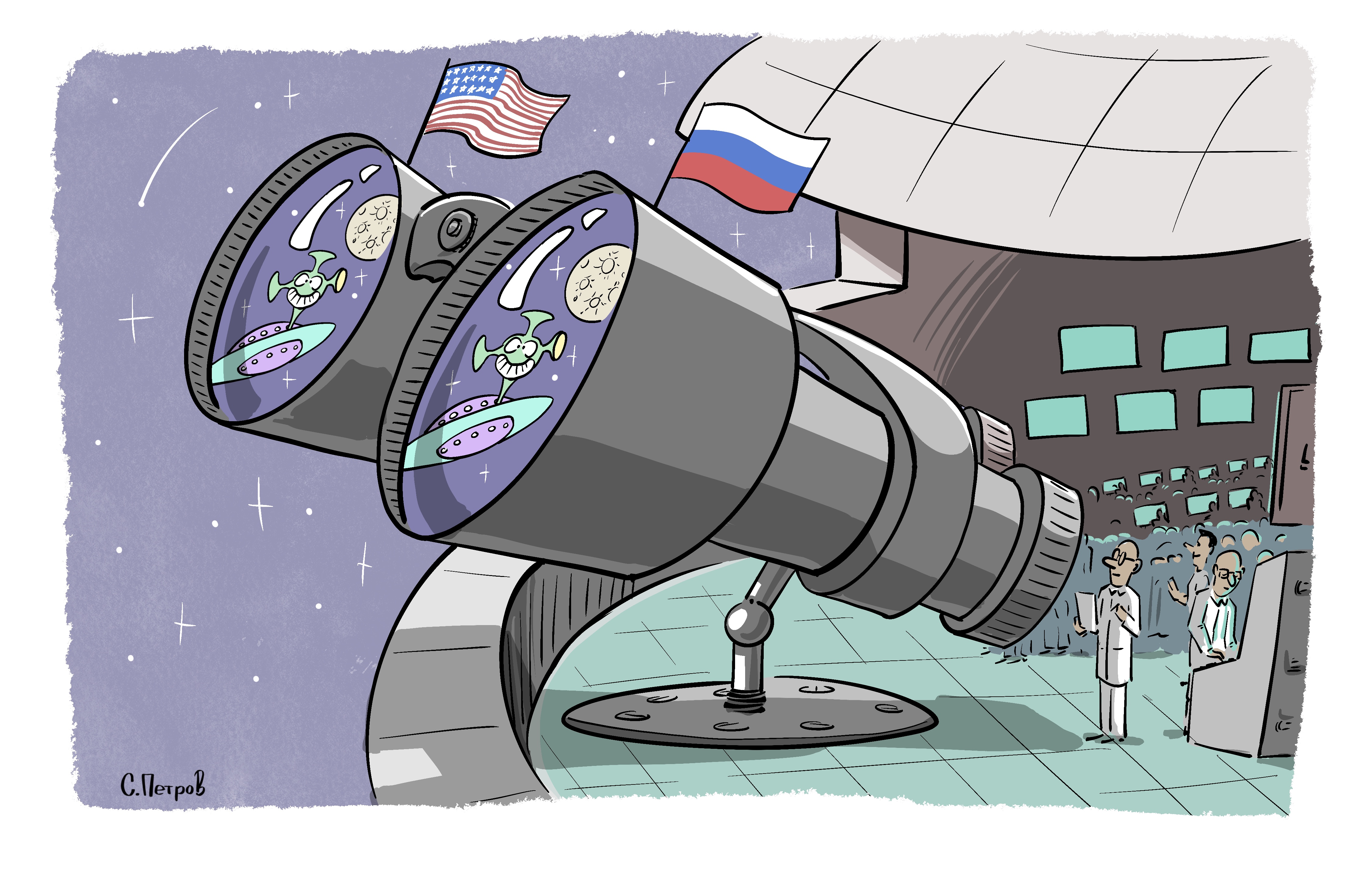
Over the past 100 years, world science has already received significant benefits from the cooperation of scientists from Russia and the United States. Thus, the fundamental work of the Soviet astrophysicist Joseph Shklovsky "The Universe, life, mind" was written in collaboration with the American astronomer Carl Sagan.
Rebooting the relationship
Space cooperation between Moscow and Washington has repeatedly served as a kind of "reset button." It is enough to recall the joint Soyuz–Apollo flight in 1975. Its political significance went far beyond the mission itself, says Peter Punchenko, senior lecturer at St. Petersburg State University of Aerospace Instrumentation and expert at the BRICS-Russia Council.
— Therefore, as a political gesture, such an initiative is quite real. Especially when it comes to general civilizational issues like the search for extraterrestrial life. Both sides can present such cooperation as a contribution to the common future of humanity, and no one will have to explain why he made concessions to the other side. It's a pretty convenient topic to start a rapprochement," he said.
From the Russian side, the Space Research Institute of the Russian Academy of Sciences, the Special Astrophysical Observatory and scientific groups of Moscow State University could participate in the joint work. On the American side, there are Harvard, the SETI Institute, and other university groups. Scientific ties between the United States and Russia have been developing for decades, and they are backed by professional trust and the experience of several generations. It would be a waste to lose it all because of the current political differences.
— For now, we remain hopeful that further space exploration will become a common cause. The costs and tasks are too high to avoid joining forces in advance. Therefore, even a small research project today can pave the way for a much larger program in the future," said Pyotr Punchenko.
The willingness to engage in projects designed for years ahead is also important for bilateral relations. This means that Moscow and Washington admit the possibility of rapprochement and are ready to gradually create conditions for it. The search for extraterrestrial life is quite suitable for such a start, the expert is sure.
Russia and the United States are already separately implementing projects to search for extraterrestrial life. The SETI Institute uses the Allen telescope array of 42 antennas to search for signals in the radio range, and the Breakthrough Listen international project rents radio telescopes for observations. Avi Loeb, as part of the Galileo project, is looking for material evidence of extraterrestrial technological civilizations by creating a network of ground-based telescopes. NASA is trying to find signs of microbial life as part of the Mars program, and the Europa Clipper mission is exploring Europa, a satellite of Jupiter, to assess the possibility of life in the subsurface ocean. The James Webb Space Telescope explores the atmospheres of exoplanets. Russian scientists are studying Lake Vostok in Antarctica as a model for searching for life in extreme conditions similar to the oceans of Europe. Signals from extraterrestrial civilizations are also searched for using radio telescopes, including RATAN-600 in Karachay-Cherkessia— the world's largest radio telescope with a 600 m diameter reflex mirror.
According to Russian scientists, currently there is practically no cooperation between our countries in this area for political reasons.
— This is impossible due to the current political conditions. Although there are interesting American and Russian projects. We are looking for optical transients (phenomena that dramatically change their brightness. — Ed.) on several systems. In fact, these are flashes of alien lasers. Work is also underway in the radio range on the RATAN-600. We are leading the world in this area. But all this is based solely on enthusiasm," said Alexander Panov, a leading researcher at the Moscow State Institute of Nuclear Physics and a specialist in the search for extraterrestrial civilizations.
Russia and the United States should join forces in the search for extraterrestrial life, as this is one of the most urgent scientific tasks, says corresponding member of the Russian Academy of Cosmonautics named after K.E. Tsiolkovsky Andrey Ionin.
— I really hope that our countries, China and the BRICS countries will explore space together. This is a task for all of humanity. Deep space observation methods necessary for the search for life have become more accessible, both technologically and financially. They are available even to private companies," said Andrey Ionin.

For example, one of Russian space companies is considering the possibility of launching a satellite with a gravitational lens at a distance of 500 astronomical units (one astronomical unit is about 150 million km) with a special maneuver near the Sun. This will make it possible to observe the surfaces of exoplanets at a distance of tens of light-years, the expert said.
According to Pyotr Punchenko, Trump has already fueled interest in the topic of aliens several times with promises to reveal classified materials about UFOs. This topic attracts him with a combination of great public interest, opportunities for American leadership, and personal historical ambitions. Becoming a president under whom humanity discovered another civilization is quite in his style. Scientists can spend decades searching for evidence, but the name of the politician who announced the discovery will remain in textbooks next to them.
Переведено сервисом «Яндекс Переводчик»
