- Статьи
- Economy
- The hall is small but expensive: cinema box office receipts may reach pre-pandemic levels in 2026

The hall is small but expensive: cinema box office receipts may reach pre-pandemic levels in 2026

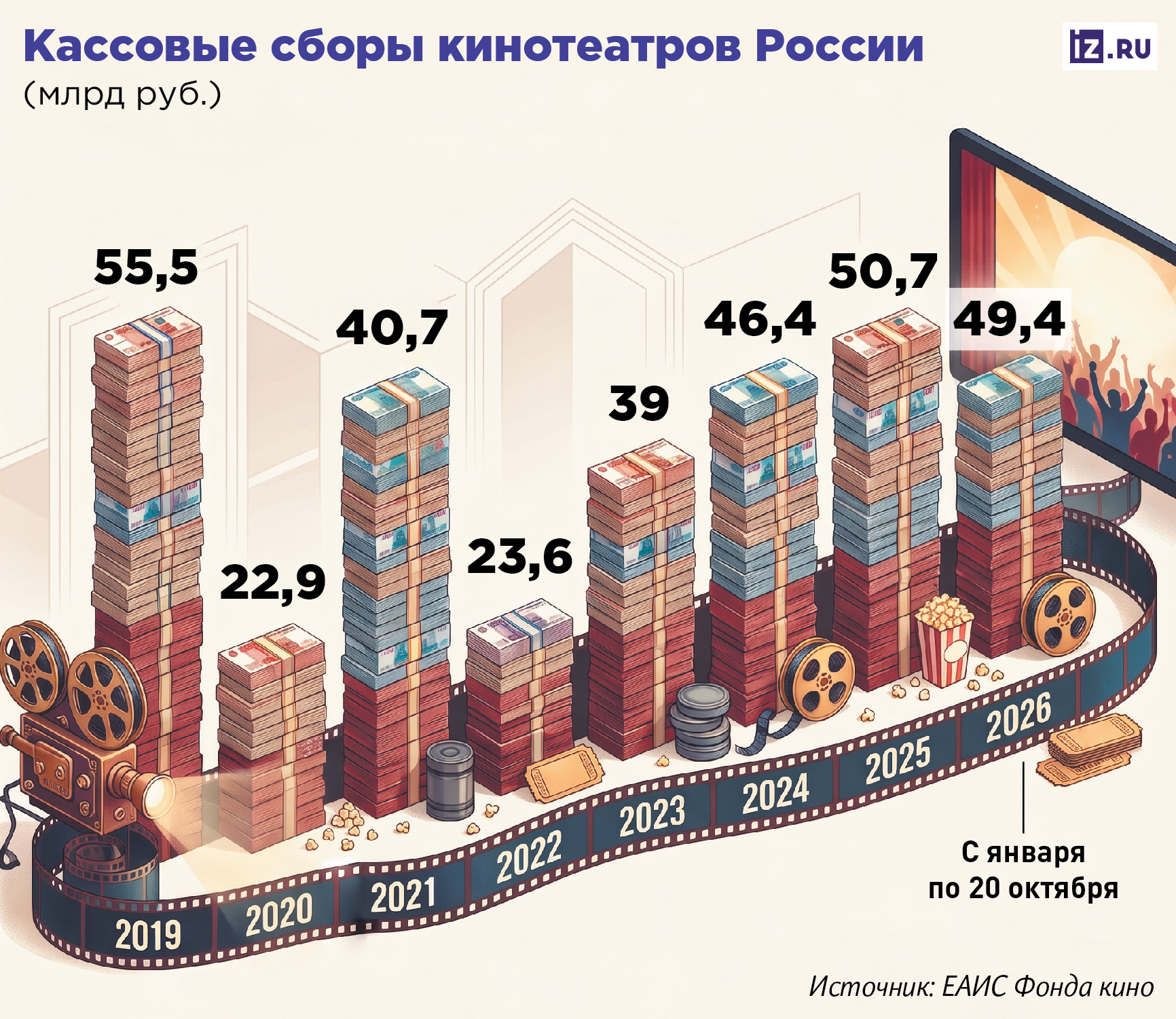
The box office receipts of Russian cinemas in 2026 may reach the pre—pandemic level of 55 billion rubles, experts interviewed by Izvestia believe. By mid-October, they had exceeded 49 billion rubles, the editorial office calculated based on data from the EAIS Film Foundation. However, the return to the figures of seven years ago indicates the stagnation of the market. In recent years, the industry has grown mainly due to higher ticket prices and an increase in the number of domestic films at the box office. According to experts, the market has not yet completed its recovery. Among the deterrent factors are the illegal screening of Hollywood films, slow growth in attendance, as well as competition for viewers from online cinemas and pirate platforms.
What is the reason for the restoration of film distribution
As of October 20, box office receipts in Russian cinemas amounted to 49.3 billion rubles, which is 31.5% more than in the same period of 2025 (37.5 billion), according to the data of the EAIS Cinema Fund. At the same time, by the end of 2026, the industry may exceed pre—pandemic figures - in 2019, the turnover of cinemas amounted to 55 billion rubles, according to experts interviewed by Izvestia.

According to Vladimir Petelin, General Director of the Premier Hall cinema chain, this is an absolutely achievable indicator. CEO of Infoline.Analysts Mikhail Burmistrov believes that by the end of the year, the turnover of cinemas may amount to at least 60 billion rubles.
Experts agree that the market is recovering slowly relative to 2019. The main increase is provided by increasing ticket prices. According to the results of January – August 2026, the average ticket price was 446 rubles, which is 8.1% more than in the same period of 2025, Izvestia calculated based on Rosstat data. According to Yandex Afisha, in the second quarter, the average cinema ticket order reached 1,084 rubles, an increase of 6.9% year-on-year. At the same time, we are talking about an average receipt, which may include several tickets, said Enrico Mazavrishvili, director of content and business development at the online service.
Attendance has traditionally remained the main indicator of the state of the film industry. It is growing, but it is still far from reaching the pre-pandemic level. According to the EAIS Film Foundation, since the beginning of 2026, more than 102 million people have visited cinemas - 15.5% more than in the same period of 2025. For the whole of last year, the attendance was 118 million people, while in 2019 this figure was more than 220 million viewers.

The growth in attendance is also confirmed by the data from Yandex Afisha. In January – August 2026, 4.3 million movie tickets were sold on the platform, which is 39% more than in the same period of 2025. A total of 5.2 million tickets were sold last year, which is 20.3% more than in 2024. At the same time, sales growth is observed not only in large cities, but also in small towns, noted Enrico Mazavrishvili.
Another important indicator is the number of operating cinemas. According to Cinemaplex, in two years in cities with a population of 50,000 or more, their number has hardly changed: 1,244 in 2024 versus 1,245 today. At the same time, 35 new venues opened in capitals and cities with a population of one million during this period, while 34 closed in small and medium-sized cities. The authors of the study attribute this dynamic to economic factors: in particular, revenues from film screenings in Moscow are higher than in the regions.

New opportunities for the film industry
Russian cinema has serious prospects, says the director and Chairman of the Board of the Kino Foundation.&The Stanislav Ershov Theater. He cites the departure of foreign players as one of the key reasons. In 2022, foreign companies, including Disney, Warner Bros., Universal, Sony and Paramount, stopped the official distribution of their films in Russia.
Another important driver of the industry was the expansion of the repertoire, added Vladimir Petelin. If there were about 500 titles at the box office before the pandemic, now there are about 700-800.
— Previously, most of the bright films were released during the New Year holidays, so cinema attendance was traditionally low in the summer. Gradually, the repertoire is distributed more evenly throughout the year, which allows us to speak more confidently about the growth of the audience," he explained.

However, this trend is still emerging, said Vladimir Petelin. Major releases are still coming out closer to the New Year holidays. Nevertheless, several striking domestic paintings were shown this summer. For example, the box office receipts of the film "Serf 3" amounted to 1.2 billion rubles in Russia and the CIS countries, and "The Last Hero. Kolobok" — more than 1 billion.

What is holding back the development of the industry
At the same time, each of the industry's drivers has its downside, experts say. Thus, the increase in ticket prices supports the film industry, but at the same time makes trips to the cinema less affordable, said Stanislav Ershov. Another problem is the lack of variety in the repertoire.
— We are always rushing from one extreme to the other. Now these are fairy tales: new ones come out every week, which, it seems to me, the audience is already a little tired of. There are much fewer serious, kind and simple films that are interesting to a mass audience," he believes.
Another significant deterrent remains the "gray" rental, in which cinemas show Hollywood novelties according to the "pre-screening service" scheme. According to the expert, this practice should be abandoned.
— We have been striving for decades to make the Russian film market civilized. I agree with those who believe that now the country has a chance to create and develop its own film industry. But so far we are not using it effectively enough," said Stanislav Ershov.

Serious risks for cinemas are also associated with competition from Russian TV series on online platforms, Mikhail Burmistrov added.
Market participants expect that the industry will continue to recover in the near future, despite the ongoing financial instability. Film production and box office receipts will grow, but the market is still heavily dependent on government support and the release of family blockbusters. Izvestia sent inquiries to the Ministry of Culture and major cinema chains.
In the long term, cinemas can switch to an "event-based model" of operation to increase payback, Vladimir Petelin believes. In addition to film premieres, they will include small concerts, apartment parties and performances by stand-up comedians.
Переведено сервисом «Яндекс Переводчик»
