- Статьи
- Science and technology
- Fire assistance: kamikaze drones will extinguish fires with a volumetric explosion

Fire assistance: kamikaze drones will extinguish fires with a volumetric explosion

Kamikaze drones have been developed in Russia to extinguish fires in hard-to-reach places where ground vehicles cannot pass and fire ladders and hoses are not available. The technology involves the use of devices that penetrate into rooms and explode, suppressing the flame with a detonation wave and sprayed fire extinguishing powder. However, the method has drawbacks: the explosion has an indiscriminate effect on the environment. Therefore, the use of such drones requires careful consideration and possible consequences, experts explain to Izvestia.
How drones are replacing firefighters in police stations
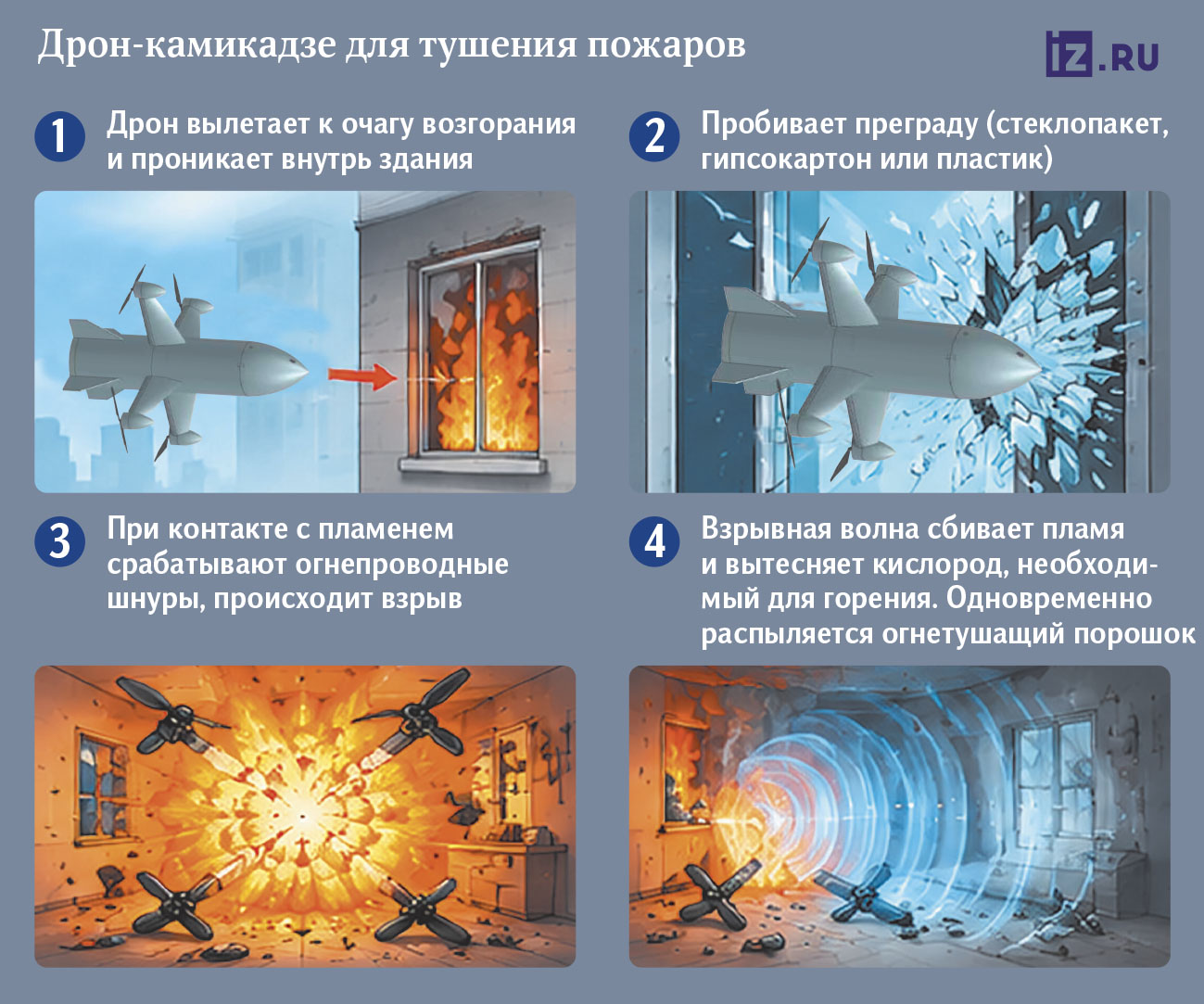
The development is based on extinguishing a fire indoors using a volumetric explosion, rather than affecting the hearth from the outside, as with traditional methods. According to experts, the device is a vertical unmanned take-off and landing drone with original propeller-driven designs that ensure maneuverability. The device was developed by engineers of Kazan National Research Technical University named after A.N. Tupolev — KAI.
The drone can launch from unprepared sites, which allows it to be launched in cramped conditions — for example, from a cramped courtyard, from a roof balcony or a neighboring building.
— The aircraft has a rocket-shaped body that reduces air resistance. The pointed and reinforced nose hood allows you to break through obstacles on the way to the fire source. Thanks to this drone, it is possible to consider double—glazed windows, plasterboard or plastic partitions," explained Ilfir Abdullin, one of the developers, Associate professor of the Department of Aircraft Structures and Design at KNRTU-KAI.

Special fire-fighting environments equipped with fire-conducting cords are installed inside the devices. "They activate the system upon contact with the flame," the specialist explained.
As a result, an explosion occurs, destroying the body of the drone. The detonation wave spreads out to the sides, knocking down the flame and expelling oxygen from the room, causing gorenje. Fire extinguishing powder is sprayed with the same spray gun.
According to the developer, the technology can be used where standard fire extinguishing equipment is not available, for example, on the upper floors of high—rise buildings, in deep corridors and elevator shafts. In addition, the drone can help firefighters if access to the building is obstructed by parked vehicles.

Another possible area of application is areas where the work of rescuers poses a threat to life and health, in particular, at the risk of collapse of structures or poisoning gorenje products. To extinguish large fires, the developers suggest using groups of drones.

How drones will replace firefighters in dangerous areas
— Emergency services have already tested drones capable of lifting a fire hose to the height of a burning room. However, such devices are limited by the length of the hose and can only operate outside the building. The new drones are capable of flying inside buildings engulfed in flames, which expands the capabilities of firefighters. For example, while the crew is climbing the stairs, the drone may be able to bring down the flames and thus facilitate the work of rescuers," said Artem Bogatyrev, market expert at Aeronet Research Institute.

At the same time, it is difficult to control drones in conditions of smoke, the expert noted. This will require special tools. In addition, strong turbulent air flows occur in burning rooms, which make the flight unstable and may interfere with the task. Therefore, the technology must first be tested at landfills.
— Before using such devices, it is important to make sure that there are no people left in the burning and neighboring rooms. In addition, the presence of pyrotechnic devices on board implies a special procedure for allowing operators to work with them. It is also necessary to develop rules and regulations for the use of such devices," the expert added.

According to Alexey Karfidov, Head of the Department of Technological Equipment Engineering at NUST MISIS, explosive drones are in demand in the military sphere, and the proposed solution will allow adapting this technology for civilian tasks. At the same time, it is important to learn how to quickly assess the situation and predict the possible consequences of using devices for nearby objects and structures.
— Of particular interest is the use of such devices for extinguishing fires at hazardous facilities, including on the territory of nuclear power plants. They can quickly deliver fire extinguishing equipment to hard-to—reach areas, inspect premises without risk to personnel and work where access is limited due to radiation, chemical or other factors," said Vladimir Zenin, Deputy Director of the Research Center for Artificial Intelligence in the field of Transport and Logistics at the National Research Nuclear University MEPhI.

At the same time, the use of kamikaze drones with a volumetric explosion requires special caution, the expert says. In particular, it is necessary to carefully select the construction materials: during detonation, fragments should not damage a significant part of the equipment and cable systems. In addition, the use of such devices should be coordinated with a change in the security location.
As an alternative, replacement technology can be installed in complexes of autonomous vehicles with remote control, artificial intelligence and machine vision, suggested Vladimir Zenin. Having received a fire alarm, they can still reach the fire site, begin to localize it and thereby reduce possible damage. Such systems can be especially useful at remote sites where automatic fire extinguishing systems are not provided, where it takes a long time for emergency services to reach the target.
Переведено сервисом «Яндекс Переводчик»
