And he immediately sang: the opera "Moscow - Petushki" was presented at the Tone Center
- Статьи
- Culture
- And he immediately sang: the opera "Moscow - Petushki" was presented at the Tone Center


Real trains rush past the panoramic windows of the Tone Center, and on the stage, Venichka invites viewers to another train - either real or metaphysical, but definitely following the Moscow– Petushki route. Bottles are clinking, deadly cocktails are bubbling, angels are pouring alcohol, and the choir is singing the funeral service for a passenger who is still looking for a way to heaven. For the first time, Venedikt Yerofeyev's poem acquired an operatic sound — with music from gas tanks, church chants and the sound of wheels. Izvestia embarked on this journey on a general run to find out if it was possible to sing about eternity without sobering up on the way.
Paradise is under the dome, and a train is outside the window.
"Moscow – Petushki" without any conventions is a cult work of its time. Over the years, attempts have been made to translate Yerofeyev's lively text into an operatic style, but it did not come to a stage embodiment. And in this sense, the experiment of composer Peter Aida, production designer Katya Bochavar and librettist Grigory Krotenko already deserves a place in musical history. The first stage production of the opera appeared at the Tone Center. The premiere took place on October 15th. The next screenings will take place on the 16th and 17th.
The realization of the idea became possible with the advent of the site itself. The tone Center opened in the summer of 2026 in the building of the Circular Depot on Komsomolskaya Square. Since the middle of the 19th century, steam locomotives were deployed here, and then the building was abandoned for a long time. Now it's hard to imagine a place more suitable for a Yerofeyev trip. Behind the panoramic windows is an active railway. The trains are running on schedule. They don't care at all that a few meters away from them, a Broom is trying to get to the Cocks, to her beloved red-haired whore and her son, who already knows the letter "Yu".
There is a conditional carriage on the semicircular catwalks. Seats, partitions, flashing lights. No naturalism and no attempt to copy the reserved seat in every detail. Katya Bochavar's set design is minimalistic, but the space does not require unnecessary decorations. Under the dome of the former depot, the building itself becomes part of the performance. It resembles at the same time a railway station, a temple and a huge bowl in which human voices, music and the noise of the railway mix.
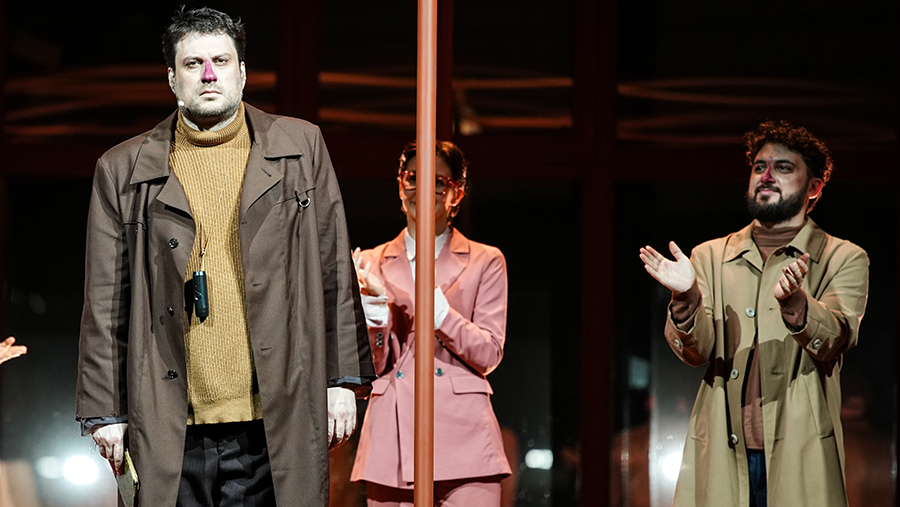
Passengers in sweatpants, stretched leggings, and sweaters are sitting on spring couches. And everyone has the reddening nose of a seasoned drinker. In the center of this picturesque company, of course, is a broom.
At the sound of bells, the audience sets off along with him. However, where exactly the hero is going is not entirely obvious. In Cockerels? Into your own past? To heaven? Or to a point from which they no longer return? In Yerofeyev's poem, the road has long ceased to be just a road. She turned into a space between life and death, reality and delirium, prayer and a hangover.
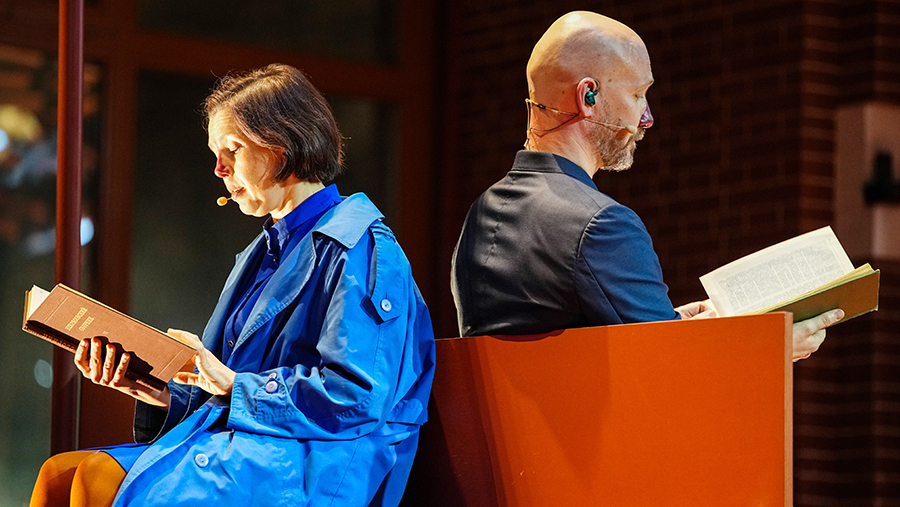
Venichka is an alcoholic, but he is also an intellectual. Sip by sip, he opens philosophical questions like a rusty can opener. He talks to fellow travelers, remembers great thinkers, and addresses angels, the sphinx, and God. And when it starts to sober up, proven remedies come to the rescue.: "Canaan Balm", "The Spirit of Geneva", "Komsomolka's Tear", "Aunt Klava's Kiss". Technical alcohol, White Lilac perfume, foot sweating remedy and everything else that burns, burns and promises to postpone the meeting with reality for a while.
Along with this fiery mixture, music also flows. Rough and gentle, aggressive and divine. It's not easy to figure out the plot, even with the libretto given to the audience. But it has its own truth. The Yerofeyev text is generally not very amenable to retelling. You have to listen to Him the way you listen to a late-night conversation in the kitchen, where one interlocutor suddenly remembers God, the second offers you a drink, and the third is already telling an absolutely incredible story.

Music from a bottle
Yerofeyev had a unique auditory memory. For him, music was not an ornament to life, but a way to perceive it. In the opera "Moscow – Petushki" it is everywhere: in the sound of wheels, the voices of fellow travelers, bells, pauses and silence. Composer Peter Aidu is not trying to drown out this world with the usual orchestral splendor. On the contrary, he collects music from what is at hand: glass bottles, bells and gas tanks. Although there are also traditional instruments in the orchestra pit: piano, trumpets, violin. The game involves hitting a rubber toy chicken, smacking chupa chups, clicks, noises and beatboxing.
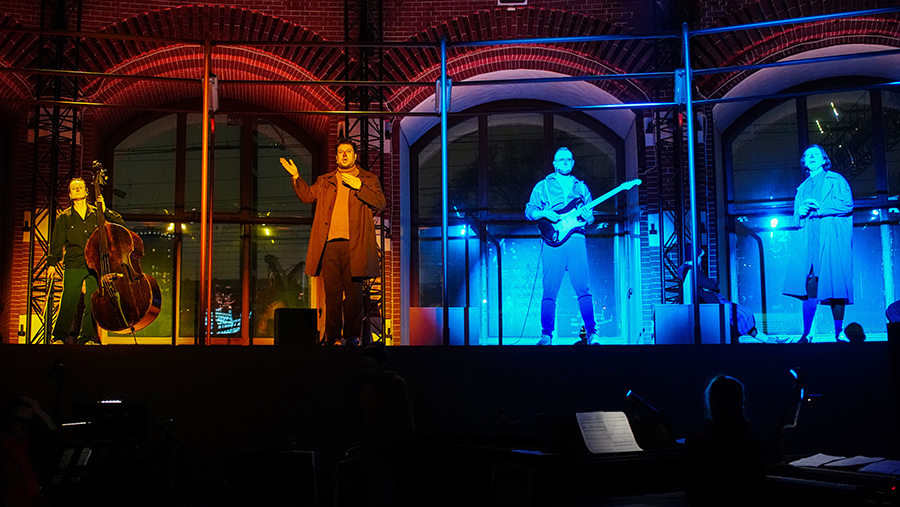
This opera has another important feature. Her main character is not exactly a Broom. At least, that's how Grigory Krotenko, who wrote the libretto and performs the central role himself, explains it. Venichka is not just a drunken passenger with philosophical ambitions. This is a man who is always trying to break through to something bigger than himself. And the more ridiculous his cocktails are, the more serious the questions sound. Meekly interprets his hero as a fool, almost like Christ. Hence the form of the prayer for the chalice. The angels bring Venichka another deadly mixture, and he drinks them over and over again.
A particularly strong moment appears closer to the finale. Venichka uses an electrolaryngophone, a device that turns her voice into a mechanical, almost robotic sound. It's not just a spectacular detail. In the last years of his life, after removing his larynx due to a cancerous tumor, Venedikt Yerofeyev used such a device himself.
There are many religious motifs in the play. Bell ringing, church intonations, prayer form of individual episodes. The domed space itself resembles a temple. But this is not a temple in the usual sense. Here they pray and drink, confess and swear, talk about salvation and immediately commit another stupidity.
All these musical attractions sometimes make the audience laugh, sometimes frighten, and some even force them to leave the hall. Peter Aidu confessed that working on the opera had become his favorite toy: he was constantly adding and changing something. But despite his reverent attitude to the text of the poem, he failed to convey its meaning on stage.
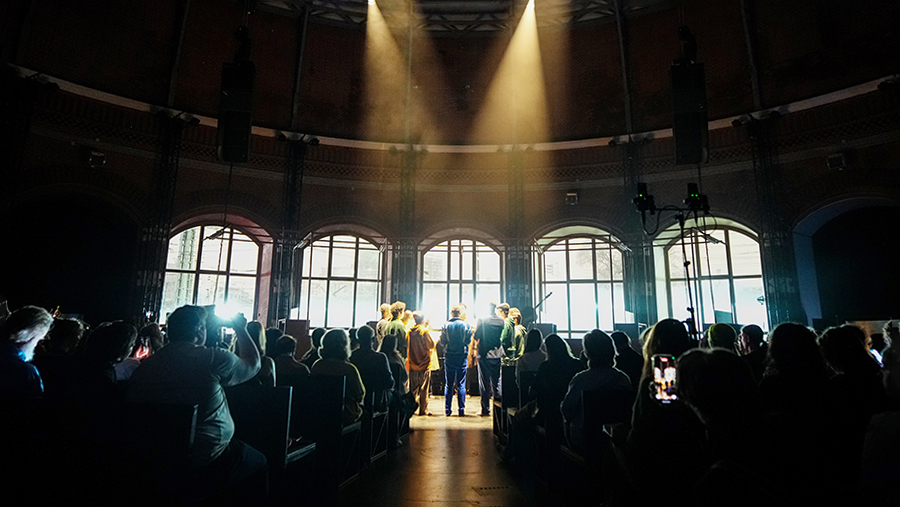
In the finale, the choir sings a funeral service for Venichka. The voices first roll out under the dome, fill the hall, and then dissolve. Suddenly the stage is empty. And at that moment, another train is rushing casually outside the windows. Perhaps a Broom is also riding in it, pours another portion of bitter water and immediately drinks it.
Переведено сервисом «Яндекс Переводчик»
