- Статьи
- Culture
- The Flaw of History: how the rhetoric about the Nuremberg trials has changed in popular culture

The Flaw of History: how the rhetoric about the Nuremberg trials has changed in popular culture

Exactly 80 years ago, the world witnessed the finale of one of the most high-profile lawsuits in the entire history of mankind. The execution of ten Nazi leaders, including Wilhelm Keitel, Joachim von Ribbentrop, Alfred Rosenberg and Wilhelm Frick, marked the end of an era of impunity. To this day, the Nuremberg trials do not let go of artists: cinematographers, theater directors and museum workers turn to this topic again and again. Izvestia decided to recall how she sounded in the cinema and on stage in different years, and reflect on what has changed in her perception over the past decades.
From fair judges to charismatic villains
The first attempts to open the curtain on what was happening in Hall No. 600 of the Nuremberg Palace of Justice were made shortly after the verdict. The debut film on the subject was the documentary "The Court of Nations", presented by the Soviet Union on November 15, 1946. The hour—long painting sought to show the process as rawly as possible - while the feeling of victory over evil has not subsided yet, and what is happening has not turned into a distant story.

An image from the film "The Nuremberg Trials", directed by Stanley Kramer
After 15 years, filmmakers are returning to this topic en masse. In 1961, the films "The Black Fox" about Adolf Hitler and "The Nuremberg Trials" by Stanley Kramer were released one after the other. The latter became the first dramatic film on the subject and instantly acquired the status of a benchmark, depicting in detail the legal subtleties of the process and paying tribute to each country that took part in it. The filmmakers continued to treat the topic with care and respect for all those affected. The documentaries released over the next 10 years followed the same principles.

The first signs of simplifying the topic in favor of the current agenda emerged in the noughties. Then the TV movie "Nuremberg" was released with Alec Baldwin as Judge Robert Jackson, who took over all the attention and the main decisions. Russian General Jonah Nikitchenko was played by Len Doncheff — the image was pretty stung and made into a caricature. But at least the court itself was still a court.
In recent years, there has been a tendency in world cinema to talk about the Nuremberg trials through scope and deep psychology. In Russia, director Nikolai Lebedev, who released the film "Nuremberg" in 2023, was one of the last to address this problem. The drama with Sergei Bezrukov and Lyubov Aksenova turned a German city into a playground for undercover games and love between a captive Russian girl and a Soviet translator who went through the war.

A shot from the film "Nuremberg"
The creators of the tape deliberately abandoned the meticulous reconstruction, giving the familiar plot a fresh dynamic. The painting also includes a frightening fire scene: it was created without special effects, setting fire to the real scenery. Lebedev saw the didactic story of good and evil as an action-packed blockbuster with intrigue and high emotional stakes. In fact, the director outlined the previous ideas using a more modern language.
In the same year, the psychological drama "Nuremberg. The Multidimensionality of evil" by Chuvash documentary filmmaker Alex Plath. The cinematographer told the story of the commandant of Auschwitz Rudolf Hess and the Soviet psychiatrist Evgeny Krasnushkin. The latter hypnotizes the Nazi and reveals a frightening psychological portrait that partly explains, although it does not justify, the deeds of Hitler and his followers. Plath's version is as close to reality as possible: the author does not spare the viewer and demonstrates the behavior of the Nazis in all its burning abomination. The premiere went almost unnoticed, but failed to leave those who watched the picture indifferent.
American director James Vanderbilt also dared to get into the Nazi's head in 2025. He turned to the figure of Herman Goering (Russell Crowe), the only one who did not wait for the execution of the sentence and committed suicide in prison. Rami Malek, who plays psychiatrist Douglas Kelly, is paired with Crowe. In the pursuit of mind games, the cinematographer sacrificed common sense. The author was deeply immersed in the cat-and—mouse between the main characters, so much so that the Nuremberg trials themselves faded into the background and lost historical credibility. Vanderbilt ruthlessly cut out characters who could have made the plot more realistic: in particular, representatives of the Soviet Union, who simply do not exist in the film, got hurt. You can study the complex relationship between criminals and those who try to understand them in any other setting — it makes no sense to rewrite history for this.

A shot from the film "Nuremberg"
Afraid of appearing unoriginal, filmmakers are abandoning graphic documentaries and looking for a new approach to a familiar topic. However, the pursuit of entertainment is not always beneficial: the creators risk moving away from the original source, and most importantly, forgetting about the international nature of the trial, turning it into the background of the story of one hero.

Dramas and cartoons
In recent years, the Nuremberg Trials have attracted more and more attention from theater directors. Productions on this topic have appeared in RAMTA, the Gorky Moscow Art Theater, the Modern Theater and on many other stages. The play "Nuremberg" in RAMTA is based on the Oscar-winning drama by Stanley Kramer and recreates the course of the trial with historical accuracy. In the Nuremberg Waltz, staged at the Gorky Moscow Art Theater in 2020, the same events are shown through the tragic love story of two translators. And Yuri Grymov's play "We Don't Need Flowers" addresses the consequences of the trial and shows how its outcome affected the fate of people 20 years later.

Production of "Nuremberg" at the RAMT Theater
Museums pay a lot of attention to the process. So, in the winter of 2025, the exhibition "Nuremberg: The Unknown about the Known" was opened at the Moscow Victory Museum, where photographs, drawings and newspaper clippings from 1945-1946 were presented, depicting the events of the Nuremberg Tribunal through the eyes of contemporaries. A separate part of the exhibition was devoted to the work of Boris Yefimov, who attended the meetings as a cartoonist for Izvestia.
The artist's most complete works dedicated to the Nuremberg Tribunal, including a unique notebook with sketches from the courtroom, were presented in 2025 at a joint exhibition of Izvestia and the Russian Academy of Arts at the Zurab Tsereteli Art Gallery. The opening of the exhibition was timed to coincide with the 80th anniversary of the beginning of the tribunal and the 125th anniversary of the artist's birth.
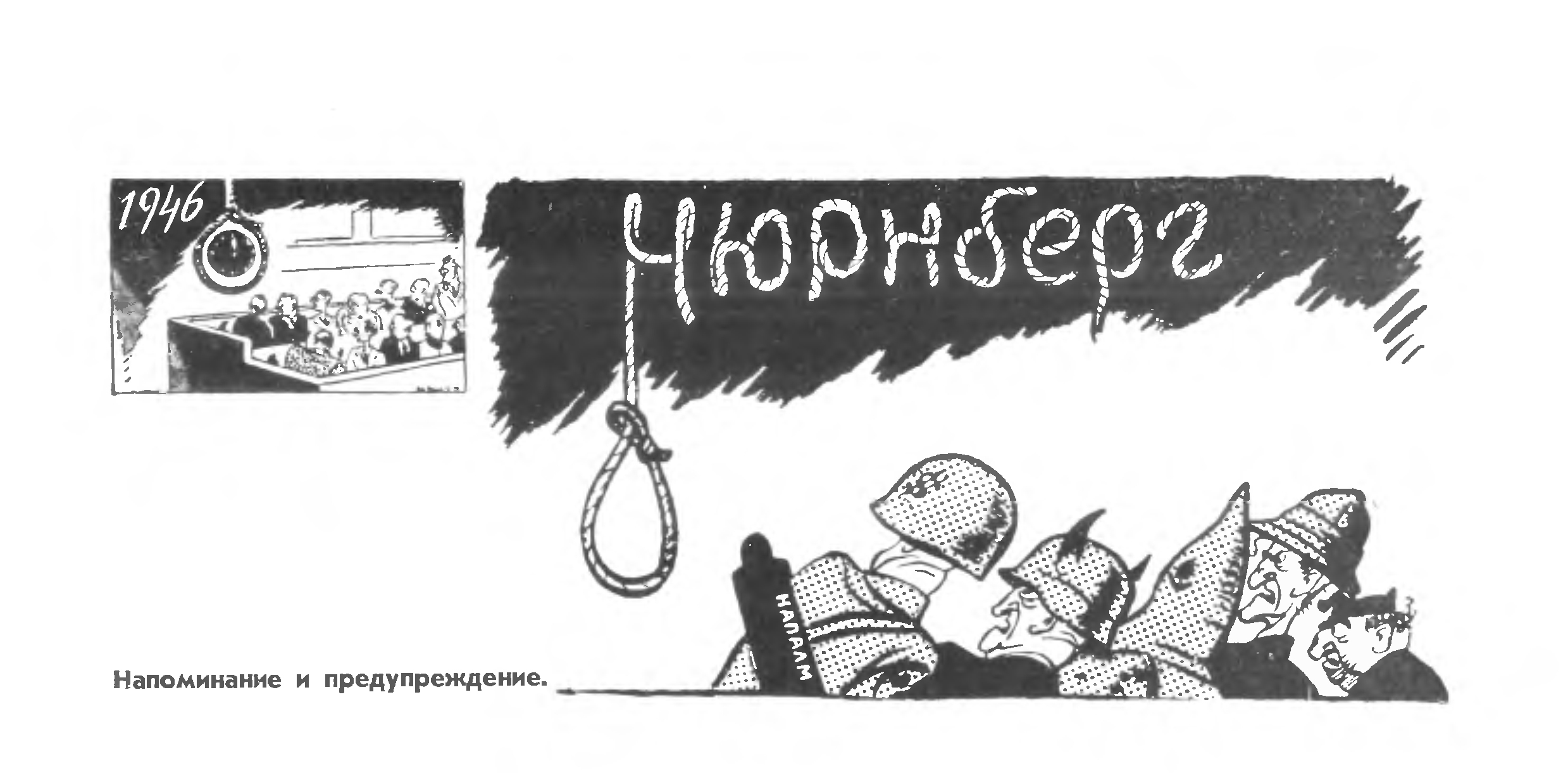
Turning to this topic, each work eventually leads to one conclusion: no matter how evil is explained, it must be punished. Art cannot stop war crimes, but it can remind us that violence does not always have to generate new violence. Sometimes evil must have a clear and unambiguous ending — without moral compromises and discrepancies.
Переведено сервисом «Яндекс Переводчик»
