- Статьи
- Science and technology
- Scientific coverage: Battery-free robots and a new cure for tuberculosis

Scientific coverage: Battery-free robots and a new cure for tuberculosis

China has successfully tested a battery—free microrobot, the United States has found a new way to fight cancer by reprogramming immune cells inside the body, and Russia has learned how to optimize electricity consumption on the railroad, recognize stress by changing breathing, and defeat tuberculosis without antibiotics. Read more about the interesting science news for the week in the Izvestia collection.
In China, microrobots will be able to work without a battery
Researchers from Fudan University have developed a membrane that turns every step of a robot into energy. A polymer film as thick as a human hair is formed on his feet by a chemical process. It works like an open battery: the surface releases electrons, and oxygen and moisture from the environment close the electrical circuit. In the laboratory, the microrobot has already taken more than 1 million steps without voltage drop, providing energy to an LED and even a Bluetooth transmitter. But before using the device in real conditions, it is necessary to increase the wear resistance of the internal electrolyte, since carbon dioxide from the atmosphere destroys it.

Researchers have to manually replenish the supply of potassium hydroxide in order for the system to work correctly. In addition, the membrane cannot receive energy from chemically inert surfaces such as glass, plastic, soil and organic materials, which greatly hinders practical use, so the developers installed a capacitor on board the microrobot, which makes it possible to smooth out power outages and weighs significantly less than energy storage devices. According to them, the lack of a battery will significantly reduce the size and weight of new devices, and in the future they will be able to become indispensable in exploring hard-to-reach places and searching for earthquake survivors.

New Russian drug will defeat resistant tuberculosis in two weeks
Specialists from the National Medical Research Center for Phthisiopulmonology and Infectious Diseases of the Russian Ministry of Health have completed preclinical studies of a new inhaled drug based on the natural mycobacteriophage D29, a special virus capable of destroying Mycobacterium tuberculosis. During the experiments, it showed its effectiveness against 50 different strains of Koch's bacillus, half of which were resistant to antibiotics. At the same time, the course of medication is only two weeks. The developers have received comprehensive data on the pharmacokinetics and the absence of toxic effects of the drug. Preparations are underway for the start of phase I clinical trials involving humans.
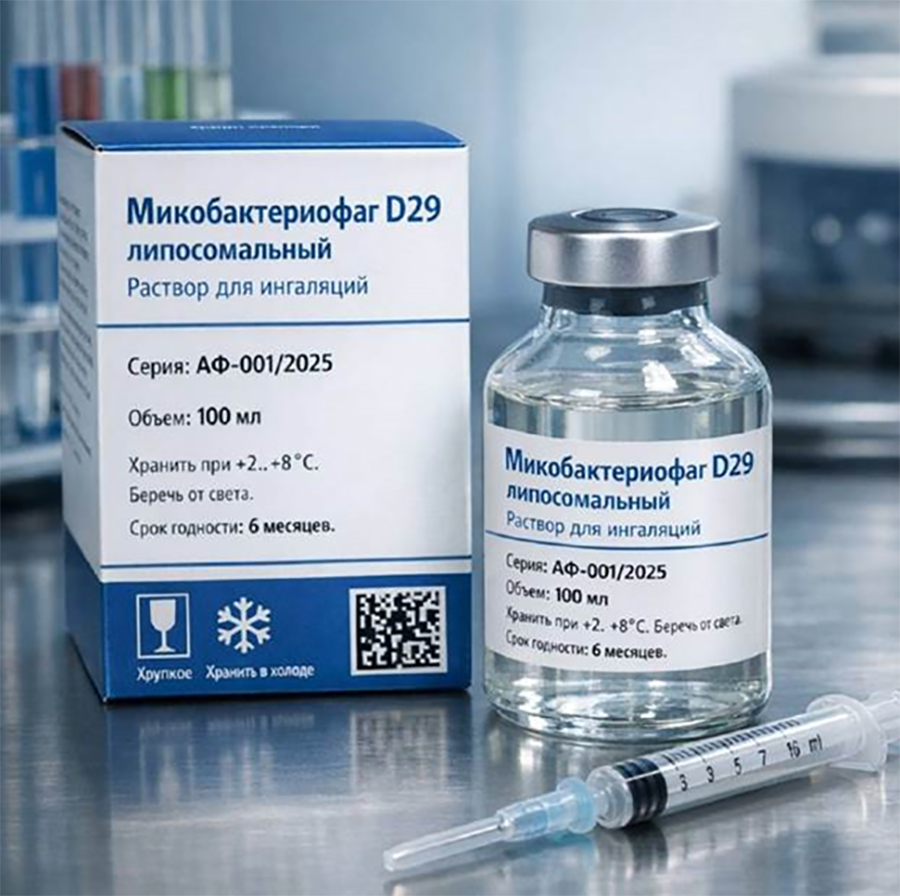
The results obtained at the preclinical stage need to be confirmed in real patients. It is also important to show that Koch's bacillus does not develop resistance to this bacteriophage, as the bacterium has learned to adapt to other viruses hostile to itself, said immunologist Mikhail Bolkov.
— If the effectiveness is confirmed in the clinic, the drug will not be able to completely replace antibiotics. Bacteria have developed resistance to other bacteriophages, so they need to be changed, just like classic drugs. Even if it doesn't apply to this virus, evolution always has some kind of adaptation mechanism," the expert said.
According to him, the absence of side effects is a great advantage of bacteriophages, so they can be used to treat patients with concomitant diseases and weakened immune systems who suffer from tuberculosis most often.
In the USA, they learned how to reprogram cells to fight cancer
Researchers from the Massachusetts Institute of Technology have found a way to fight cancer and autoimmune diseases without expensive CAR therapy, which involves "reconfiguring" the patient's immune cells. The new method makes it possible to reprogram NK cells designed to protect the body so that they hit specific targets. At the same time, scientists do not extract cells from the body, but send instructions there using lipid nanoparticles with messenger RNA. In preclinical trials, about 80% of immune cells were modified in this way.

Experiments on mice have shown that the new treatment method is comparable to traditional CAR therapy, but much simpler and cheaper. In tests, cells reprogrammed directly in the body successfully destroyed tumors and fought autoimmune hepatitis. According to the researchers, the development can be used in the treatment of T-cell tumors, multiple sclerosis and rheumatoid arthritis, but first it is necessary to confirm the safety and effectiveness of the method.
Trains can be operated more efficiently in Russia
Specialists from Omsk State University of Railways have created an algorithm that will optimize electricity consumption on railways and increase the service life of trains.

In the new model, the scientists combined physical equations and machine learning methods. The algorithm takes into account not only the mass and characteristics of the train, but also the weather conditions and the condition of the track. Thanks to training on 1.5 thousand real trips of electric locomotives, he is able to calculate the resistance that a train experiences during different movement options, which theoretical models could not do.

The system will allow the development of train management strategies adapted to specific conditions, which will make it possible to save electricity, reducing its consumption wherever possible.
A computer algorithm recognizes stress by changing breathing.
Researchers at Petrozavodsk State University, together with colleagues from Binali Yildirim University of Turkey in Erzincan, have taught a computer algorithm to detect signs of stress based on breathing parameters.

Experts compared the two approaches. In the first case, a compact neural network analyzed the respiratory wave directly. In the second case, respiration characteristics were previously extracted from the signal — for example, features of the waveform, changes in rhythm at different frequencies, and its stability over time. These parameters were then used to determine a person's condition.
The best result was shown by a compact neural network that analyzed the original signal.: she correctly identified the presence or absence of stress in more than 96% of cases. At the same time, not only the breathing rate was associated with stress, but also other features such as the duration of inspiration, the shape of the respiratory wave, and changes in rhythm over time. Thus, the algorithm relied on a combination of several features rather than a single indicator.
Based on the results of the study, scientists have developed a free Android application — BreathCouple. Unlike the experiment, which used a chest sensor, the app registers breathing using a compact external microphone connected to a smartphone. It should be placed next to your nose to record your inhales and exhales. Based on this data, the program builds a respiratory wave and allows you to track the frequency and fluctuations of the breathing rhythm.
Переведено сервисом «Яндекс Переводчик»
