Breaststroke and done: the stage in Astana can be a triumph for Russian swimmers


The final stage of the Short Course Swimming World Cup will be held in the capital of Kazakhstan on October 15-17. After the competitions in Baku and Tashkent, Russian Egor Kornev leads the overall standings, repeating one world record and setting another. But the gap from the star rivals is only a few points. The whole struggle is still ahead. Evgenia Chikunova, Ilya Borodin, Kirill Prigoda, Ralina Gilyazova and other national team leaders will also compete for medals in Astana.
Minimum difference
The first two launch stages of the Silk Road Tour were held in Baku (October 1-3) and Tashkent (October 8-10). Astana will host the final stage for the first time. The swims will take place in the swimming pool of the Barys Arena complex.
The winners of the series are determined not by the team medal standings, but by an individual rating. At each stage, the three best results of the swimmer are taken into account, points are awarded for the place taken and the time shown. The total prize fund is $1.2 million. A $10,000 prize is awarded for a world record, and the same amount is awarded for the Triple Crown, which is a victory over the same distance on all three stages. Plus, a place in the top three of the finals, if the standard is met, gives you a chance to get an additional ticket to the December World Championships in Beijing.
In April, World Aquatics restored the right of Russian swimmers to perform with the flag and anthem. With national symbols in Azerbaijan, Russians won 18 medals (5-7-6), in Uzbekistan — 20 (5-8-7), taking first place in the medal standings.
"Our team is inspired to finally perform in full," Vladimir Salnikov, First Vice President of the Russian Aquatics Federation, told Izvestia. — They feel it, and they have a desire to demonstrate their best results, which sometimes become world records. I watched the first two stages on TV, and I'll come to the third one in person. I'm interested to see which opponents the Russians will have to fight at the World Cup, and in two years at the Olympics.
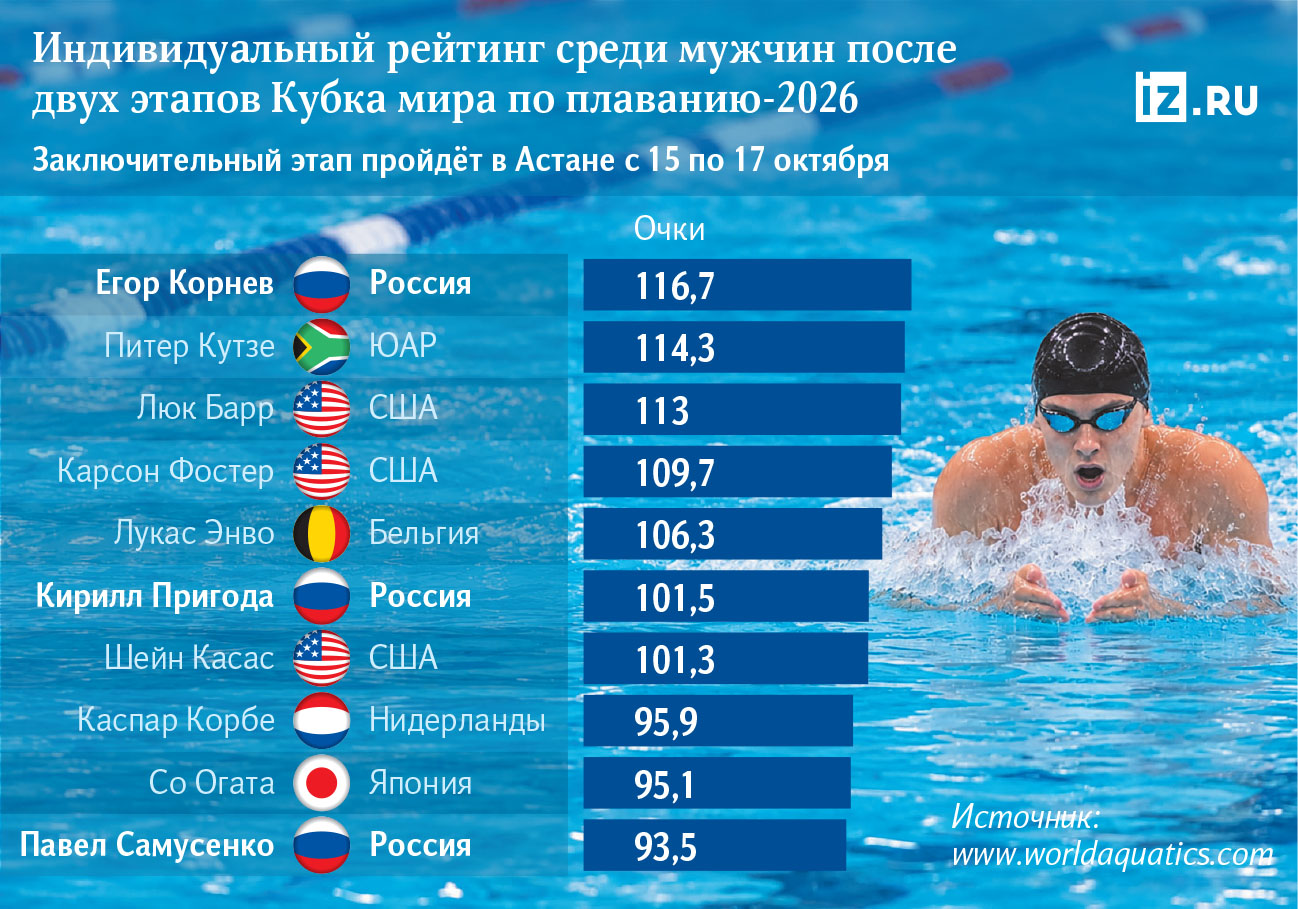
Egor Kornev became the main star of these starts. At the 2026 World Championships in Paris, he won a personal gold in the 50 m butterfly, two silver medals in the freestyle and three medals in the relay. He has already won five World Cups and taken three second places. In Baku, the Russian repeated the world record in the 100 m freestyle — 44.84 seconds — and won the 50 m backstroke and butterfly. In Tashkent, he won the 100—meter freestyle again, and in the 50 m butterfly set a world record of 21.28, bettering the achievement of Swiss Noe Ponty (21.32).
Kornev has 116.7 points in the overall standings, South African Peter Koetze has 114.3, and American Luke Barr has 113. The leader may still change. In Tashkent, Ketze set a world record for 50 m backstroke (22.09) and swam 100 m backstroke in 48.21 — just five hundredths of the world record. He is able to take points from a Russian both at individual distances and in the ranking.
A separate intrigue is Egor's confrontation with Olympic champion Cameron McAvoy in the 50 m freestyle. The Australian defeated Kornev in Baku (20.22 vs. 20.26) and Tashkent (20.13 vs. 20.61). McEvoy's Tashkent time became a World Cup record. At the same time, the Australian highly appreciated the performances of the Russian in Baku.
— I think he will show the best time next week or at the stage in Kazakhstan. I think he's going to break the record again," McEvoy said of Kornev in an interview with Match TV.

A set of forms
Evgenia Chikunova won the 200 m breaststroke in Baku (2.17.20) and Tashkent (2.17.23). Now the world record holder can take the third gold in a row and the Triple Crown. The closest competitors are Dutch Tess Schouten and Irish Mona McSherry. In the 100 m breaststroke, McSherry won both stages, while Chikunova was second twice.
Kirill Prigoda also won twice— in the 100 m breaststroke, including with a score of 55.98 in Tashkent. His rivals are American Luke Barr, Dutch Kaspar Corbo and Chinese Qin Haiyang. In the 200 m breaststroke, Barr won twice, while Prigoda finished third in Tashkent. So Barr is fighting for both the Triple Crown and the overall title.
Ralina Gilyazova won the 50 m breaststroke in Tashkent for the first time: 29.76 seconds. McSherry lost nine hundredths to her, the Belgian Florine Gaspard — the tenth. The rematch is scheduled for next Saturday.
The bronze medalist of the European 100 m butterfly Championships and relay medalist Daria Klepikova in Tashkent became the second in the 100-meter freestyle (52.04) and the third in the 50 m (23.94). But the competition here is especially serious: Marrit Steenbergen from the Netherlands leads the women's overall standings with 116.7 points and set a European record in the 100 m freestyle (50.32). Poland's Katarzyna Wasik won both 50-meter freestyle events. Next to Stenbergen in the overall ranking are Chinese Yu Yiting (111 points) and Belgian Roos Vanotterdijk (108.8).
Ilya Borodin, the winner of the Paris European 400 m Championship, lost to American Carson Foster in both stages. And the titled Kliment Kolesnikov remains without awards in the World Cup so far.
— It's always been like this: World Cup competitions are needed to test your strength before the main start of the season, and not to get nosebleeds to win a separate swim or the overall standings, — explained Vladimir Salnikov. — The same Clement will still get in shape for China.
The Short Course World Cup will be held in Beijing from December 1-6.
Переведено сервисом «Яндекс Переводчик»
