
The Blind Man's Buff Game: How Australopithecines and Emperors died

The preface to the book by the tandem of French pathologists and paleopathologists Philippe Charlier and David Allier was written by their well-known Russian colleague, forensic expert and writer Alexei Reshetun, who acted as scientific editor. The main advantage of the book, according to Reshetun, is its wide historical range, which makes reading a journey from the prehistoric period (the authors investigate the death of the most ancient hominid, Australopithecus Lucy) to the present, when the French are wondering whether the restitution of human remains stored in national collections is necessary. To what extent the authors succeeded, the critic Lidia Maslova found out, especially for Izvestia.
Philippe Charlier, David Allier
"The famous dead. Secrets of world history revealed by the scalpel of a forensic medical expert"
Moscow: Eksmo, 2026. — Translated from the French by D. V. Bondarevsky. — 224 p.
As Reshetun rightly points out, in the proposed collection of essays and essays, forensic medicine, paleopathology (a kind of branch of forensic medicine dealing with ancient remains), anthropology, archeology, genetics and history are combined into a single research mechanism. Sometimes philosophy is added to them, as well as morality and ethics, which is logical and even inevitable in connection with the topic of death, around which all the arguments, research and discoveries of Charlier and Allier revolve.
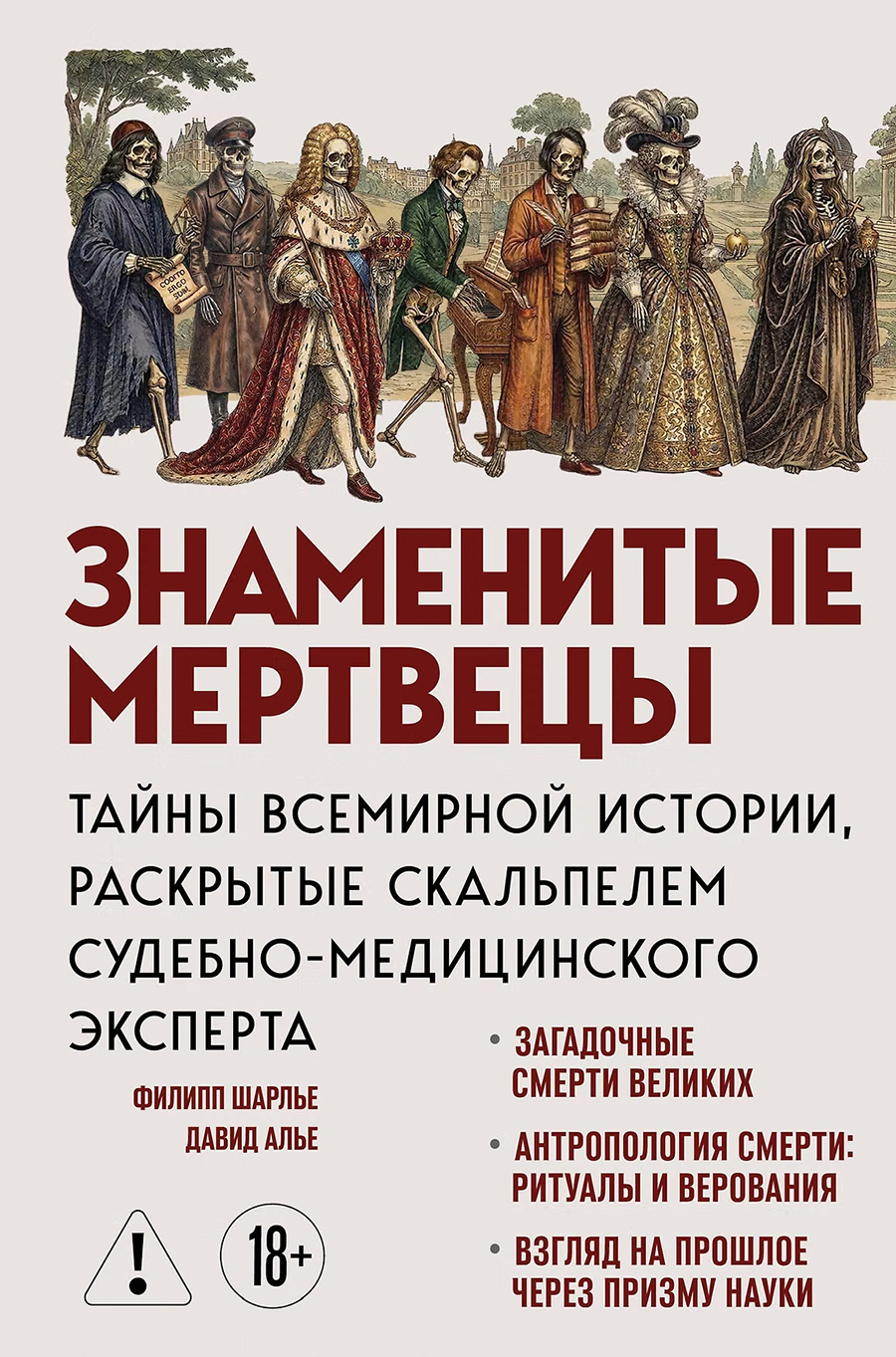
The first part of the book, devoted to the prehistoric period, deals not only with the circumstances of Lucy's death, which probably involved hungry crocodiles, but also with the causes of the disappearance of the Neanderthals, according to one version, who lost in the evolutionary competition to the more flexible Cro-Magnons. Nevertheless, the genetic heritage of the Neanderthals, who became the epitome of primitiveness, according to the authors, makes modern humans better adapted to fight microbes, cold and humidity. Already in the prehistoric part of the book, Charlier and Allier throw a bridge into modernity, dedicating the first chapter to "The Doomed Death. "Jurassic Park of Ancient Diseases" requires extremely careful handling of ancient human remains, which may contain quite viable infectious agents.
The shortest part of The Famous Dead, related to antiquity, contains a somewhat feminist essay on the perception of the female body in Ancient Greece. In it, among other things, the authors solemnly state that "in addition to female psychology, which men often cannot understand, the female body represents for the male a tangle of contradictions, where intertwined desire and mystery." And the chapter with the humorous title "When anthropology is pulled by the hair" talks about the benefits of studying hair. Here, the main characters are also sinners, but consistent and persistent, the royal favorites Agnes Sorel and Diana de Poitiers, with whom the love of gold played a cruel joke: taking it inside to preserve youth and beauty, she eventually died of poisoning.

In the third part of the book "The Middle Ages and Modern Times," sympathy is posthumously aroused by the "pious and truly Christian sovereign" Louis IX, whom the authors call the "dismembered king" in the chapter "Puzzle of Remains." There was disagreement between his eldest son, the new King Philip III the Bold, and the younger brother of the late Charles of Anjou, King of the Two Sicilies, about the burial of the remains of Louis, who led the Eighth Crusade at the time of his death and was in enemy territory. But this was only the beginning of the amazing adventures of Louis' remains, which became a special object of worship after his canonization.
Charlier and Allier talk very fascinatingly about how the "distribution" of the relics of Saint Louis took place, from which every significant figure of that era dreamed of snatching at least a piece: "... Philip the Handsome presented the phalanges of his fingers to Norwegian King Haakon V, who was going to build a church dedicated to Saint Louis in Bergen. Around 1330, the Holy Roman Emperor Charles IV also received several relics and then sent them to Prague. <...> In 1616, Anna of Austria was awarded a fragment of a rib, however, angered by the fact that she got only a "particle" of the saint's remains, she eventually achieved a whole rib..." The authors of the book reveal the geopolitical background of the distribution of royal entrails and limbs in different places: the dismembered monarch thus "carried out a kind of posthumous "marking" territories. <...> In practice, this meant the establishment of royal authority in areas of influence (and therefore control) and the creation of favorable conditions for the construction of specialized necropolises."

The rib of Saint Louis obtained by Anna of Austria, however, did not help her avoid God's punishment in the form of breast cancer, which is described in the chapter "Cancer Paths: from hope to humility." The case of Anna of Austria, who died painfully for a long time, but with Christian dignity and self-denial, becomes an occasion for the authors to reflect on the causes of cancer in the past and in our days. Pathologists are debunking the philistine notion of an ancient "idyllic" lifestyle, as close to nature as possible, when cancer, the "scourge of our time," allegedly did not exist. They outline the evolution of cancer: if now some cancers characteristic of past eras (for example, those that were associated with persistent infections and parasites living in the human body) have practically disappeared, then they have been replaced by new ones caused not only by tobacco and alcohol use, but also by a variety of household chemicals, without which is impossible to imagine modern life.
Perhaps the most interesting philosophical theme of The Famous Dead, which concerns not only celebrities, is the need to prepare for a dignified encounter with death. They first address this issue in the chapter "Ars moriendi — The Art of Dying." The art of a "good death" in the Christian West. Here is a brief overview of ancient treatises that not only taught how to prepare for death every day throughout life, but also a more utilitarian express course "Preparing for death in three days", compiled by a certain Mr. Charles in 1648.

Towards the end of the book, Charlier and Allier, for their part, also help the reader to come to terms with thoughts about death, referring to the phenomenon of near-death experiences. In connection with them, I recall not only the bestseller "Life after Life" by the American Raymond Moody, which records the impressions of people who allegedly returned from the dead after a clinical death, but also the similar experience of Michel Montaigne, who was considered dead after falling from a horse for two hours. Montaigne describes his feelings at the same time as not devoid of pleasantness, reminiscent of plunging into a sweet dream.
Charlier and Allier cite other encouraging evidence that dying is not necessarily scary, such as the words of Thomas Edison, who briefly came out of a coma before his death and managed to tell his wife: "It's very beautiful there." However, finally, French scientists descend from heaven to earth and explain the gratifying near—death sensations by biochemistry - some kind of undiscovered special molecule in the human body that releases a special substance-a tranquilizer, so those who dream of eternal heavenly bliss should not be too deluded.
Переведено сервисом «Яндекс Переводчик»
