- Статьи
- Culture
- Do you like the book — the source of magic: the most mysterious texts in the history of mankind

Do you like the book — the source of magic: the most mysterious texts in the history of mankind

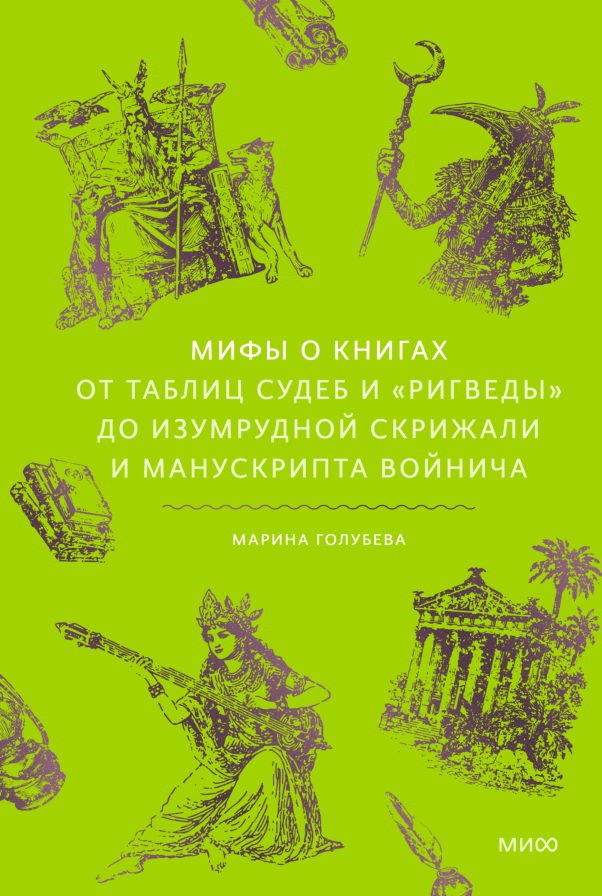
Maxim Gorky's immortal phrase "Love a book — a source of knowledge" is familiar to many from school, but Marina Golubeva focuses not on publicly available school knowledge, but on those secret, esoteric ones that humanity in different centuries was inclined to look for and assume in some legendary texts (even if most of the time they existed only in oral transmission — these will also be discussed). Critic Lidia Maslova presents the book of the week, especially for Izvestia.
Marina Golubeva
"Myths about books. From the Tables of Fate and the Rigveda to the Emerald Tablet and the Voynich Manuscript"
Moscow: MIF, 2026. — 208 p.
In the first part of the book, "Myths about the origin of writing," the author recalls that the appearance of writing about five thousand years ago in Mesopotamia played a crucial role in the development of human civilization. Writing was formed by different peoples in different ways: some created it independently and "for many centuries perfected graphic signs, honed grammar and written speech, having gone through a difficult and long journey from pictographs of pictorial writing to a harmonious alphabetic system." And others resourcefully borrowed writing from their neighbors at a convenient moment in their development, when there was an objective need for it. For example, the Eastern Slavs acquired writing along with Christianity, adapted the Church Slavonic alphabet to their daily needs, and formed a literary language based on church texts.
But one way or another, the emergence of writing is an important component of many mythologies: initially, the art of writing was interpreted as a magical gift received from gods or demons, and the written signs themselves were endowed with supernatural powers.

Golubeva goes through the most authoritative civilizations of antiquity, telling how they fared with writing — starting with its first inventors, the Sumerians with their clay tablets, continuing with the Egyptians and the peoples of Palestine, whose Old Testament prophet Moses, though he broke the first stone tablets written by the Lord, but diligently wrote down their second copy under the dictation of God..

The same part tells about Chinese hieroglyphs (invented, according to mythology, instead of gnarled knotted writing, unable to convey all the beauty of human speech) and Hindu sacred texts that the Brahmins passed from mouth to mouth, not trusting important knowledge to "fragile and short—lived material, such as dried palm leaves" - therefore, in the early Indian myths simply have no information about the origin of writing.
Further, Golubeva moves from the Scandinavian Runic script and the Celtic Oghamic alphabet to the myths of Slavic writing, noting the persistent attempts of some researchers to find evidence of the existence of an unrecognized script among the Slavs — pre-Cyrillic, pre-Christian. But due to the lack of reliable sources confirming the spread of full-fledged writing among the Slavs until the end of the 10th century, the author of the book is inclined to believe that, following the Scandinavians, who did not improve their runes, but switched to the Latin alphabet, the Slavs preferred to adapt a ready-made system of Church Slavonic writing for secular needs (although they had some proto-written signs in pre-Christian academic scientists do not deny the era).

The second part, "Heavenly Books," deals with books of forbidden knowledge that, according to legends, entered the human world in a supernatural way: they fell from the sky, were personally transmitted by God, or were found in a secret place guarded by guards. These include the "Tables of Destinies" of ancient Mesopotamia, the Egyptian "Book of the Dead" and the lesser-known but more interesting book "Amduat", which tells about the journey of the god Ra through the afterlife of the Duat, as well as the Indian Vedas, which existed orally for a long time due to the inability to convey melody and intonation in writing: "In Hinduism, great importance is attached to the vibrations of speech, which are part of the vibrations of the universe, the world of Brahma. If the ancient Sumerians and ancient Egyptians believed in the magical power of the written word, then the inhabitants of India attached more importance to the spoken word. The Vedas teach that mantras and sounds can change vibrations, and therefore transform reality."

In the same part, the Avesta collection of sacred Zoroastrian writings, the texts of the Old and New Testaments (primarily the Revelation of John the Theologian) and the Koran are analyzed. Slavic mythology in the context of the "heavenly books" is represented by the so—called "Pigeon Book" - in fact, not a book at all, but a vivid image from a medieval spiritual verse, which tells about a huge book that fell from a cloud, which no one could even approach, except Tsar David Evseevich, who, according to Golubeva, the biblical King David is guessed. He answers the questions of another character in the verse, Tsar Volot Volotovich, telling how everything in the world appeared: "the white free light", "the sun is red", "the moon is young", "the stars are frequent", "mother earth". Golubeva suggests considering the verse about the Pigeon Book, where echoes of primitive pantheism and animism can be heard, as a reflection of the Russian dual faith that had formed by the 15th century: "Christianity, which had gained a foothold in Russia, could not completely eliminate the pagan folk beliefs, which eventually became so artfully intertwined with the Christian faith that people did not see any contradiction in this unity.".

The final parts of "Myths about Books" are devoted to such a special genre of applied literature as magical grimoire books, and those mysterious phenomena of writing that, while not being the product of divine will and not possessing supernatural power, nevertheless turned out to be firmly mythologized. As one of the strangest written artifacts of the Middle Ages, Golubeva mentions the "Emerald Tablet" (Tabula smaragdina), the author of which is considered to be Hermes Trismegistus and in which, according to myth, secret knowledge about the structure of the universe is encrypted, and most importantly, the algorithm for creating the Philosopher's stone. However, for thirteen centuries no one has been able to decipher these records — Golubeva even cites the translation of the tablet from Latin into Russian as proof, describing this short text as "completely incomprehensible not only to our contemporaries, but also to alchemists and philosophers of the Middle Ages and the Renaissance."
But one of the most famous forbidden treatises of the Russian Middle Ages is extremely clear — "Aristotle's Gates", written as if on behalf of Aristotle in the epistolary genre of instructions to his pupil Alexander the Great. The philosopher's advice, as Golubeva rightly notes, is rather banal: "Alexander, know that a miser cannot be a kind person and obey the laws, just as a spendthrift cannot preserve his honor forever. In every business, the middle must be adhered to, both extremes are pernicious; and moderation must be observed in all royal affairs, otherwise the kingdom will not be able to flourish." In fact, Aristotle has nothing to do with this effective management and is mentioned rather for the sake of solidity — according to historians, the "Gates" were composed by an unknown Arabic author of the VIII–IX centuries, and they were translated into Russian in the XVI century from Hebrew, with the addition of some colorful details for reliability — in particular, instructions, how to treat Bucephalus horse. This harmless essay was included in the list of banned books only because someone came up with the idea to use it as a fortune-telling book. However, Golubeva sums up, any book can be used as a fortune-telling book. Indeed, by adjusting the optics accordingly, magic, if desired, is easy to see even between the lines of an antique telephone directory.
Переведено сервисом «Яндекс Переводчик»
