- Статьи
- Society
- The former serf was entrusted to build the symbol of St. Petersburg: 225 years since the laying of the Kazan Cathedral

The former serf was entrusted to build the symbol of St. Petersburg: 225 years since the laying of the Kazan Cathedral

The Cathedral of the Kazan Icon of the Mother of God in St. Petersburg is not just a temple, but a living chronicle of national history and an outstanding triumph of Russian architecture. Its laying on August 27, 1801 marked the beginning of the creation of the architectural ensemble, which decades later became a symbol of Russia's military glory. The Izvestia article tells how a former serf became the architect of the famous cathedral and why the cathedral's colonnade is turned towards Nevsky Prospekt.
Why did they decide to build a new Kazan Cathedral in St. Petersburg?
The construction of the new Kazan Cathedral in St. Petersburg at the beginning of the 19th century fulfilled several tasks at once, both practical and symbolic. The main reason was the lack of space: The old church could no longer accommodate the growing stream of believers.
Previously, the Church of the Nativity of the Blessed Virgin Mary stood on the site of the cathedral, which was often called Kazan, in honor of the miraculous Kazan Icon of the Mother of God that was kept there. By the end of the 18th century, the church had become too crowded: the population of St. Petersburg was growing, and the flow of believers to the shrine was constantly increasing. At the same time, the icon itself was of great importance for the city and the country, and it was necessary to create a temple for it corresponding to its status — large-scale and solemn.

In addition, at that time, Emperor Paul I sought to embody the idea of a "Russian Vatican." Since his youth, he admired St. Peter's Cathedral in Rome and wanted a temple of comparable grandeur to appear in the Russian capital: it was supposed to emphasize the status of St. Petersburg as an imperial center. This gave rise to the concept of a colonnade "in the form of outstretched arms" — modeled on St. Peter's Square by Bernini.
The project also had an important ideological significance: it was supposed to demonstrate the maturity of the national architectural school. The cathedral was built from Russian materials — Ruskeala and Tivdian marble, granite from Karelia and others — and by the efforts of Russian craftsmen. The refusal to involve foreign architects in key stages of the work emphasized the independence of Russian architecture.
"Kazan Cathedral is one of the first cathedrals. It was decided that due to the new plans for the construction of Nevsky Prospekt, developed by [architect Augustine de] Betancourt, the cathedral, like St. Isaac's, should be worthy of the city," explained historian Lev Lurie in a conversation with Izvestia.
As a former serf Voronikhin received the right to build a temple
Andrey Voronikhin was born into a family of serfs of Count Alexander Stroganov, who saw the young man's talent and became his main patron: he educated him, sent him to study and travel, granted him freedom in 1786, and later ensured that his project was approved for the Kazan Cathedral. During the construction, Stroganov did not limit himself to formal support — he headed the board of trustees and personally supervised the work, considering the cathedral the main business of his life.
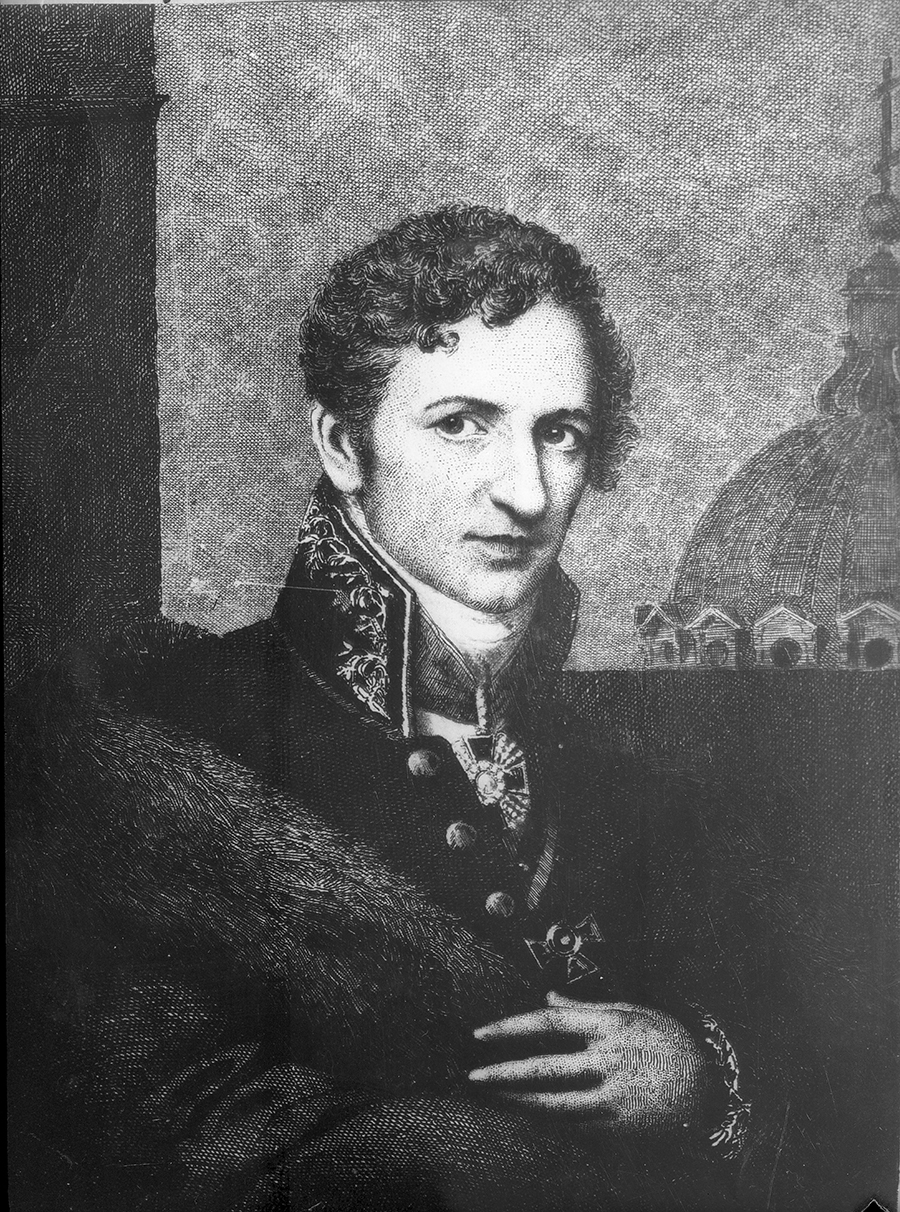
By the time of the competition for the design of the Kazan Cathedral in 1799, Voronikhin had already established himself as an outstanding specialist. In 1800, for the design of the colonnade at Samson's bucket in Peterhof, he received the title of architect, and in 1802, the title of professor of architecture. By this time, he had a solid list of completed works, and the professional community recognized his competence.
Voronikhin's project successfully corresponded to the plan of Emperor Paul I, who wanted to see in the new cathedral an echo of the greatness of St. Peter's Cathedral in Rome. At the same time, the architect did not follow the path of direct copying, but creatively rethought the sample, while simultaneously solving a difficult urban planning task: according to church canons, the main entrance should have been located in the west, but the temple had to be effectively opened towards Nevsky Prospekt.

Voronikhin found an elegant solution — the northern colonnade, which visually "turned" the cathedral to the main street of the city. This detail, as well as the scale of the project, captivated the emperor.
"The urban planning task was difficult: it was necessary to organically integrate the cathedral into the ensemble of Nevsky Prospekt. Since, according to the canons, the entrance to the temple should be on the west side, and Nevsky Prospekt runs perpendicular to this axis, it became necessary to visually "turn" the cathedral to the street. Voronikhin used the colonnade composition for this purpose. According to the original plan, there should have been two squares with two colonnades, but part of the project was abandoned," said Lev Lurie.

Voronikhin received the right to build the Kazan Cathedral thanks to the approval of his project by Paul I and the official appointment to the post of chief architect of the construction site.
"Voronikhin was a famous architect under Pavel, but his patron was Count Stroganov, and Voronikhin was a former serf of Stroganov, was close to Alexander I, and this gave Voronikhin's career a new impetus," said historian Lev Lurie.
At the same time, there was some gossip in society: some contemporaries were skeptical that such a large—scale order had gone to a former serf, and even spread rumors that the project had been "borrowed" from more famous masters, such as Vasily Bazhenov or Charles Cameron. However, Voronikhin did not allow gossip to distract him from the case and focused on the realization of his plan.
Laying the foundation stone of the Kazan Cathedral
The laying of the foundation stone of the Kazan Cathedral took place on August 27 (September 8, new style), 1801. Paul I, the initiator of the construction, did not live to see the ceremony (he was assassinated in March 1801), so the foundation stone of the cathedral was laid by his son, Emperor Alexander I. For the young monarch, this was one of the first significant steps on the throne.
The ceremony was attended by the Dowager Empress Maria Feodorovna, grand dukes and prominent nobles. The ritual was solemn: Alexander I personally laid the first brick with the monogram, using a silver spatula, and splashed lime solution on it.

This event marked the start of a large-scale project designed to make Kazan Cathedral one of the main spiritual centers of the capital. At the same time, construction work began even before the laying of the stone: in early 1801, the old church buildings were dismantled, a foundation pit was dug, about 1800 wooden piles were driven in and the foundations were laid under the walls and support pillars.
The construction of the Kazan Cathedral took ten years to complete
The construction of the Kazan Cathedral took about 10 years— from 1801 to 1811. Initially, the deadlines were much shorter: when making estimates in early 1801, the commission pledged to complete the construction in three years. However, the amount of work turned out to be much larger than expected. It was necessary not only to erect a building, but also to radically transform the land plot: to resettle the residents of eleven small houses, organize stone mining, dig ditches and solve many complex engineering problems.
Paul I's successor, Alexander I, did not abandon the construction of the cathedral, but his approach to it became more restrained. This created uncertainty and slowed down the allocation of funds. In addition, at the beginning of the 19th century, Russia fought a number of wars, and a significant part of the state resources were directed to military needs. As a result, the financing of a large-scale civil construction project turned out to be lower than planned. In 1808, it became clear that an additional large tranche was needed to complete the work, and the government had to allocate new appropriations.

The construction site was not easy: Nevsky Prospekt and the Catherine Canal passed nearby, so Andrei Voronikhin had to think over special engineering solutions to ensure the stability of the building. There were also professional difficulties: in 1804, a dispute arose with an expert involved by the commission, architect Ivan Starov, about the strength of the domed ceilings and the ceilings of the colonnade passageways. It was only after Starov's death in 1808 that Voronikhin gained more independence in decision-making.

The main part of the building, the so—called "box" of the cathedral, was built by 1811. The solemn consecration took place on September 15 (27) of the same year, on the day of the tenth anniversary of the coronation of Alexander I. At the same time, the detailed decoration of the interiors and individual decorative elements continued for some time.
How Kazan Cathedral became one of the symbols of St. Petersburg
The Kazan Cathedral was built on Nevsky Prospekt, the main artery of the city. The semicircular colonnade of the cathedral, facing the avenue, visually "embraces" the space, connects the temple with the street and masks the slight asymmetry of the building. It is this colonnade that is one of the most recognizable silhouettes of the center of St. Petersburg today.

The cathedral looked unusual and bold for its time. Voronikhin was inspired by European examples, in particular, St. Peter's Cathedral in Rome, but created an original Russian version in the style of classicism. The architect also made an engineering breakthrough: for the first time in world practice, a metal structure was used for such a large-scale dome. This showed the whole world that Russian architecture and engineering are capable of bold, innovative solutions. The cathedral quickly became one of the largest churches in the city and for a long time remained the tallest building in St. Petersburg.
"St. Peter's Cathedral in Rome is a Catholic cathedral that bears little resemblance to Orthodox churches. Kazan Cathedral is difficult to compare with any examples in Russian church architecture. Unlike St. Peter's Cathedral with its huge square in front of it, Kazan Cathedral has a different urban planning logic," emphasized Lev Lurie.
Initially, the cathedral was built to house the venerated list (copy) of the miraculous Kazan Icon of the Mother of God. For believers, this immediately gave the temple a special significance, and the connection with one of the most revered shrines in Russia firmly cemented its status.
The Patriotic War of 1812 became a key stage in the formation of the cathedral. War trophies began to be brought to the temple: French banners, standards, keys to the captured cities, the baton of Marshal Louis-Nicolas Davout. In 1813, Mikhail Kutuzov was buried in the cathedral. Before being sent to the front, the commander prayed here in front of the Kazan Icon. So the temple turned into a memorial of Russian military glory. This image became even stronger in 1837, when monuments to Kutuzov and Barclay de Tolly were erected in front of the cathedral.

"At the same time, the cathedral remained the church of the Kazan Mother of God, but it took on a different meaning — its opening in a new form coincided with the most important event, the victory in the Patriotic War," explained historian Lurie.
The cathedral's influence went far beyond the building itself: Kazanskaya Square, Kazanskaya Street, Kazan Island in the Neva Delta and Kazan Bridge were named after it. This clearly demonstrates how deeply the temple has grown into the urban fabric.
"The Kazan Cathedral has not so much set a new vector as joined the established architectural tradition. At the same time, Voronikhin's personality made a significant contribution to the perception of the urban ensemble," the expert noted.
The cathedral went through difficult periods: after the revolution, it housed the Museum of the History of Religion and Atheism, and during the Great Patriotic War, the building suffered from shelling. It was only at the end of the 20th century that divine services resumed in the cathedral, and in 2000 it received the status of a cathedral.
Today, Kazan Cathedral remains a place of attraction for both pilgrims and tourists. It organically combined the spiritual, architectural and historical elements, which is why it has become such a recognizable and significant part of the image of St. Petersburg.
Interesting facts about Kazan Cathedral
- During the construction and decoration, only domestic materials were used. The facades were faced with Pudost lime tuff, in density and color reminiscent of the Italian travertine from which St. Peter's Cathedral in Rome was built. Karelian marble, porphyry, jasper, pink and gray granite were used in the interior.
- The cathedral's northern bronze doors were modeled after the "Paradise Gates" of the Florence Baptistery, created in the 15th century by the sculptor Lorenzo Ghiberti.
- Until 1824, plaster replicas of the sculptures of the archangels stood on empty pedestals next to the colonnade — they were planned to be replaced with bronze ones eventually, but this was never done.
- In 1932, the cathedral was closed, and a Museum of the History of Religion and Atheism was opened in it. Many of the valuables from the temple were distributed to museums. However, even during this period, some Petersburgers secretly performed rituals in the cathedral — for example, they baptized children or got married, despite the official ban. During the siege of Leningrad, museum valuables from suburban palace museums were kept in the building, and museum staff lived right in the cathedral, saving it from destruction and plunder.
- In 2011, the Bank of Russia issued a commemorative silver coin with a face value of 25 rubles with the image of the Kazan Cathedral in the series "Monuments of Architecture of Russia".
Переведено сервисом «Яндекс Переводчик»
